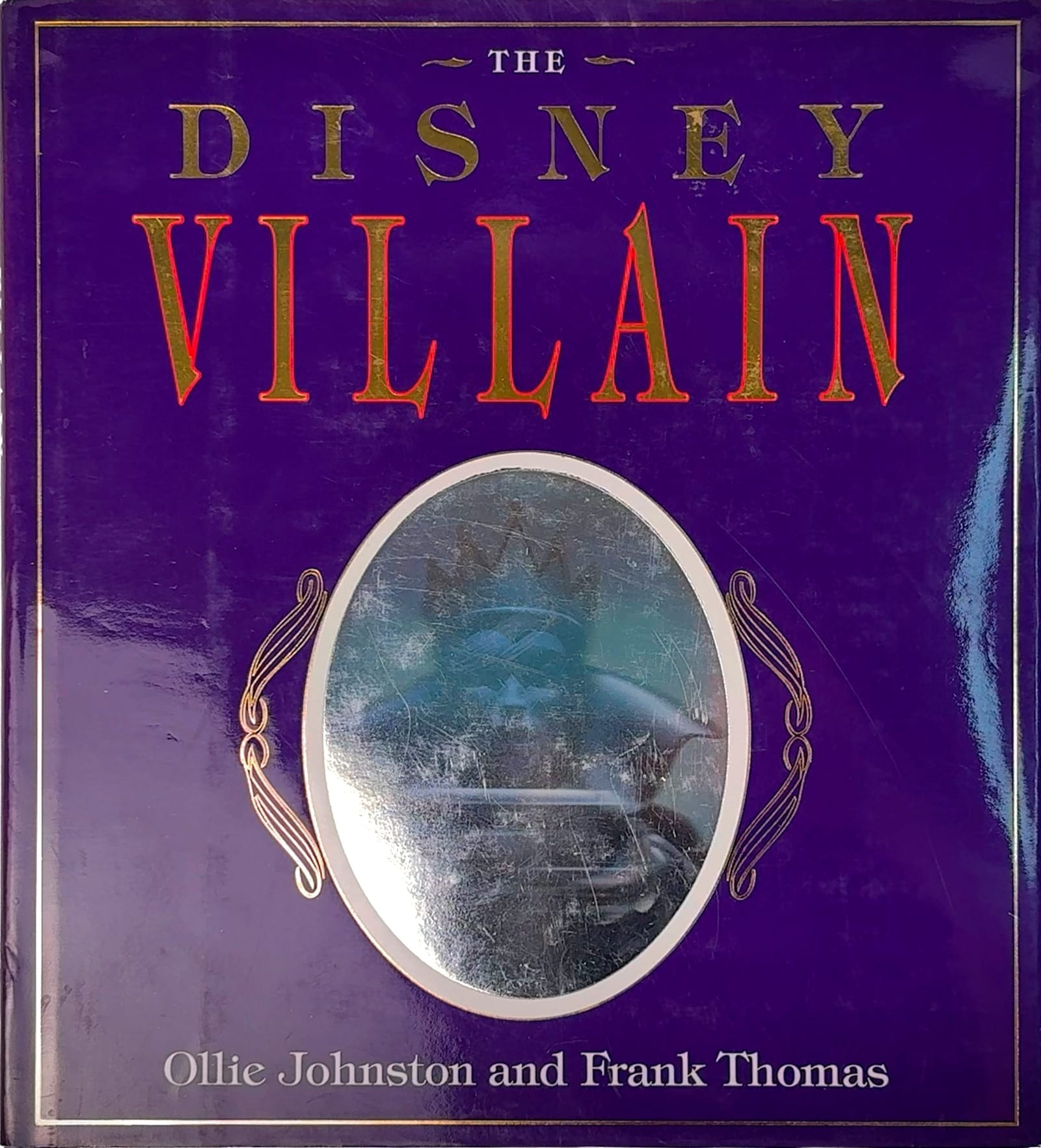
About the book
There are a lot of books about Disney villains. Very few were written by the people who actually animated them.
Ollie Johnston and Frank Thomas were two of Disney's Nine Old Men, the core group of animators who built the studio's golden age. You probably know them from The Illusion of Life, the book that gave the world the twelve principles of animation. The Disney Villain, from 1993, is them turning that same expertise on the characters everyone secretly loves most: the stepmothers, the pirates, the witches and the sorcerers.
What makes it special is that this isn't research. It's memory. Frank Thomas animated Lady Tremaine, Captain Hook, the Queen of Hearts and Madam Mim. Ollie Johnston animated Mr. Smee, Cinderella's stepsisters and Sir Hiss, and the two of them shared Prince John in Robin Hood. When they write about why Hook moves the way he does, they're telling you what they were thinking with the pencil in their hand.
First impressions
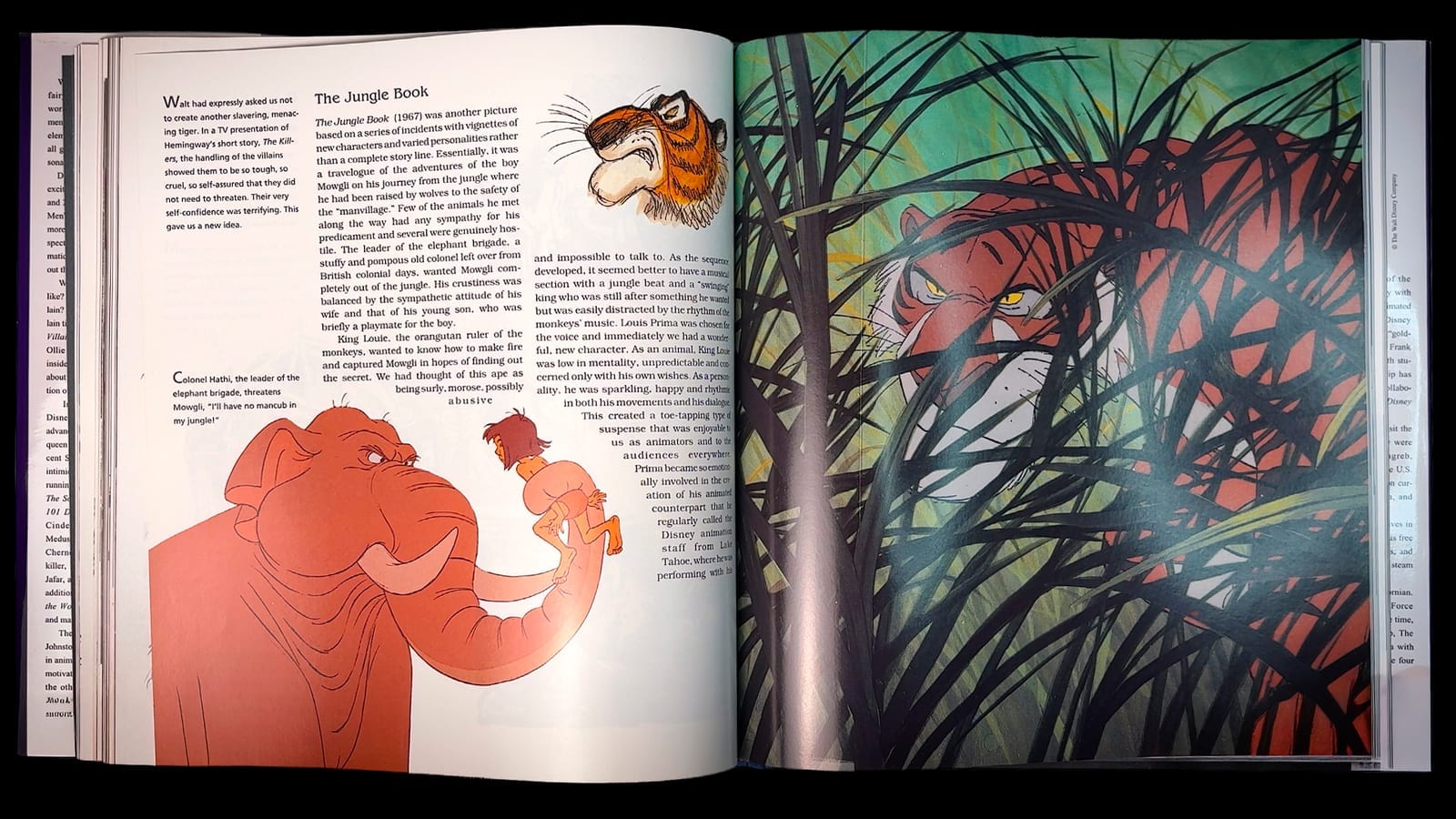
It’s a big, square, heavy book, the kind with a cloth spine and a proper dust jacket that makes you sit up straight when you open it. It’s full of colour, with around 250 illustrations: frame enlargements, cels, story sketches and the animators’ own drawings.
But the first thing you notice is the writing. This is a book you read, not one you flip through. Frank and Ollie write like two old friends telling stories at dinner, warm and opinionated and a little gossipy, and every few pages they say something that makes you rethink a film you’ve seen twenty times.
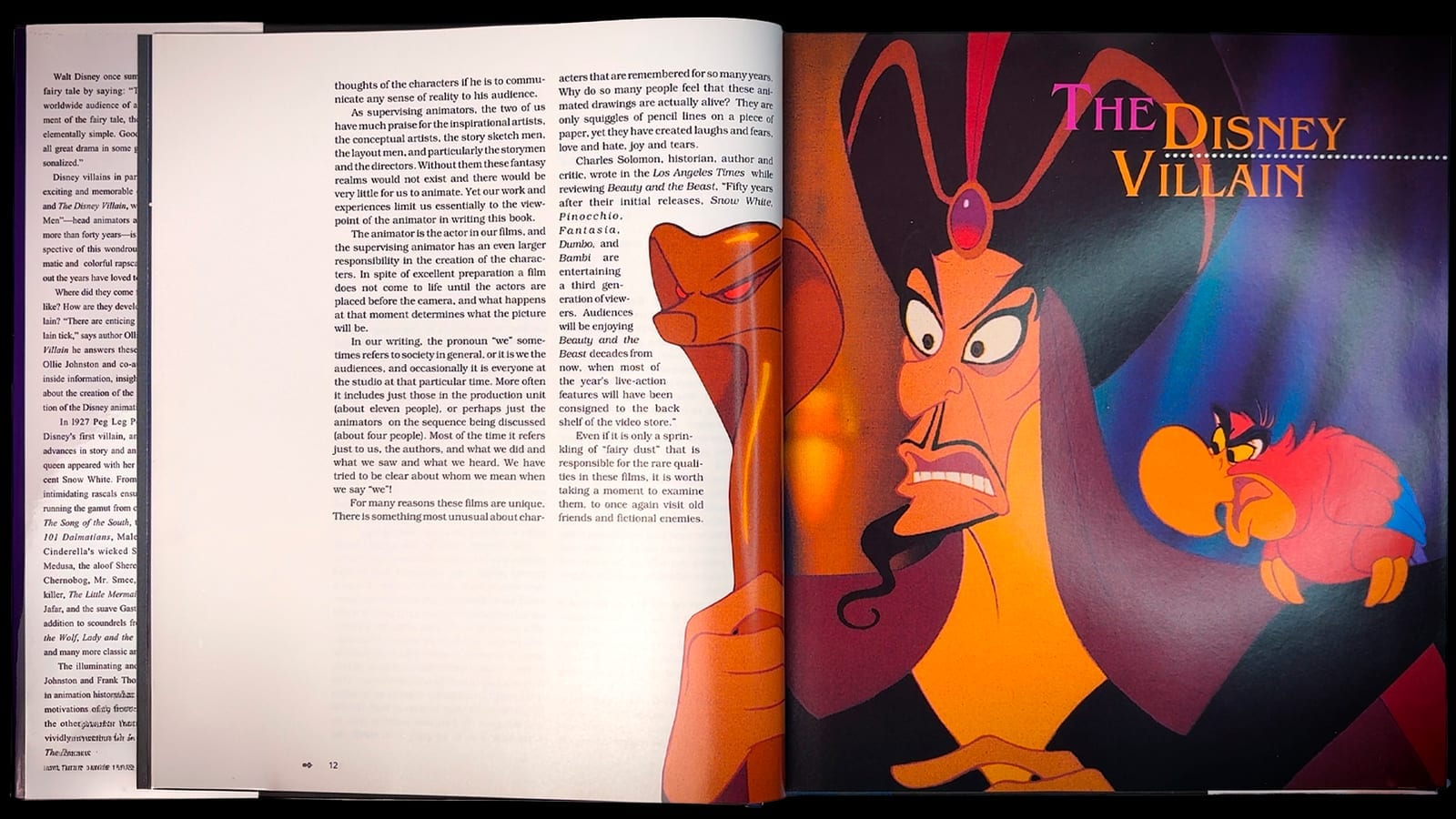
Content
The Disney Villain. Around 232 pages, oversize hardcover, Hyperion, by Ollie Johnston and Frank Thomas. Published in 1993. It profiles about 55 villains, from Peg Leg Pete in the early shorts all the way to Ursula and Jafar, and closes with an appendix showing which animator brought each villain to life.
Characters
Every villain gets a portrait, and the best ones come with stories you can’t get anywhere else.
Lady Tremaine is the one they clearly care about most. She was animated with what’s often described as “malevolent and subtle realism” — she almost never raises her voice, and that’s what makes her terrifying. Voice actress Eleanor Audley gave a performance so precise that, as Frank and Ollie put it, animating her was “a difficult assignment but a thrilling one.” The team even looked at Bette Davis in The Little Foxes for her cold, controlled look.
Cruella De Vil was made deliberately uglier than in Dodie Smith’s novel, to match the wild, scratchy style of 101 Dalmatians. Jafar gets a great breakdown of Andreas Deja’s design: long, lean and elegant, with those huge shoulders. Jeffrey Katzenberg apparently called him the most theatrical Disney villain yet.
There’s a lovely tangent about cats, too. Walt Disney didn’t like them, and for years cats in Disney films were villains by default — until his daughter Sharon pushed for friendlier ones like Figaro.
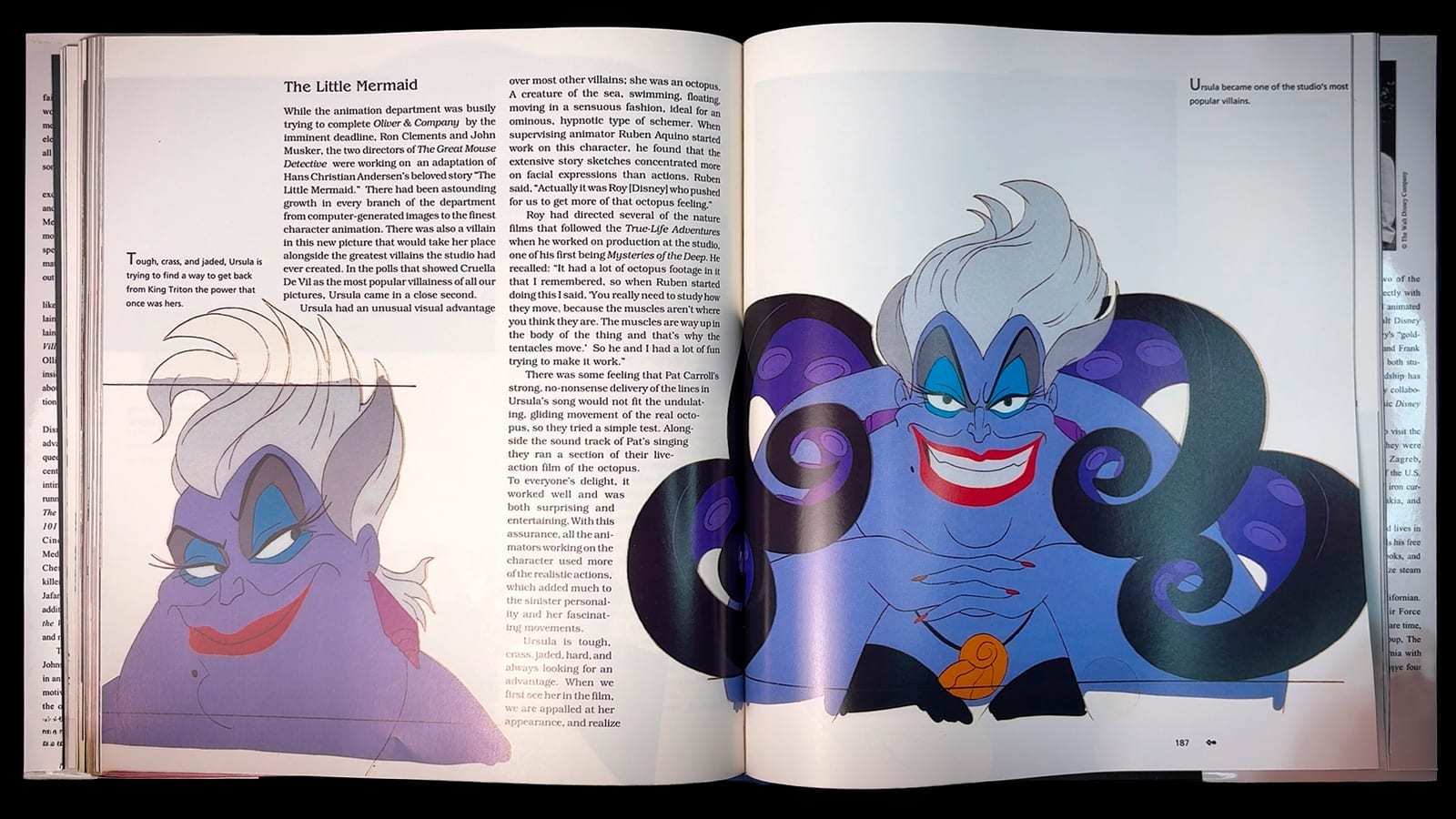
The journey through the story
The book moves through Disney history in order, from the bullies of the early shorts through the golden age, then into the later films and the newer generation of animators who made The Little Mermaid and Aladdin.
And here’s where it gets really interesting: Frank and Ollie don’t just celebrate. They judge. They argue that the true golden age ended after World War II, they talk about how Walt’s approach changed over the years, and they’re honest about the villains that didn’t work.
The best example is the Horned King from The Black Cauldron. They quote Roy Disney’s verdict, that he was “too literal-minded. He was just a guy,” and they argue he should have been as unreachable and frightening as Chernobog in Fantasia. It’s rare to read Disney people being this frank about a Disney film, and it’s a big part of why the book is so fun.
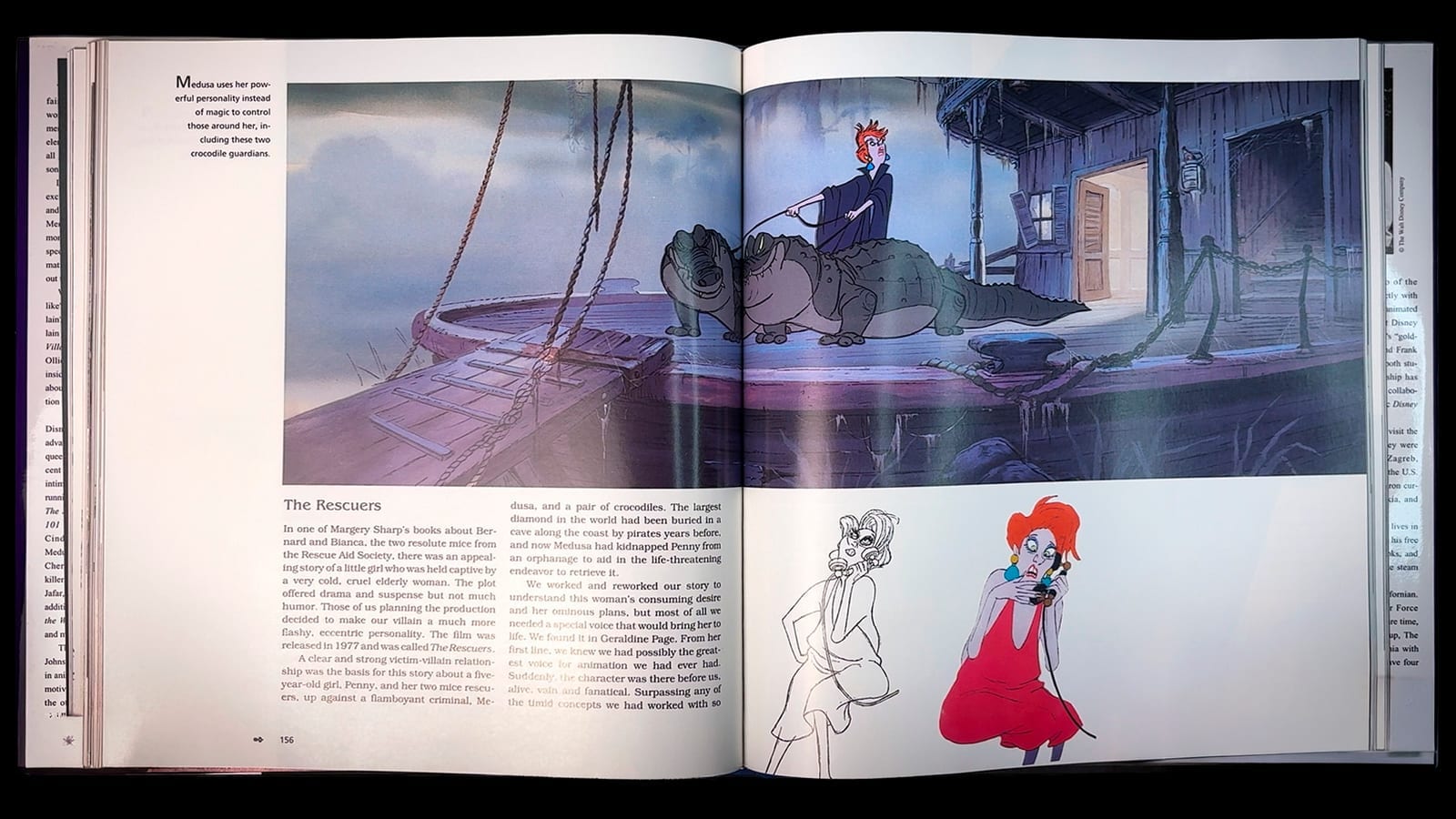
The worlds
Instead of worlds, the real subject here is what makes a villain work — and this is the part every writer, animator and storyteller should read.
Frank and Ollie sort villains into types. There are the bullies like Pete and Gaston. There are the savage wolves, the predators, and the clever ones like the Big Bad Wolf. There are the comic fools like Mr. Smee. And there are the anti-villains, characters who cause harm without real malice, like the hunter in Bambi or even the Beast. Glen Keane describes the Beast beautifully: “it’s kind of like taking the villain and the hero and wrapping them up into one body.”
Their big ideas are simple and they stick with you. Great villains feel mysterious and out of reach. A villain with a reason — frustration, pain, rejection — is more interesting than one who’s just evil. And everything about a character’s role should be readable in their shape and body language before they say a word. They’re also honest about the business side: Jafar was toned down so he wouldn’t scare small children out of a G rating.
What’s inside
The book covers the whole history of Disney’s bad guys:
- What makes a villain — the authors’ theory of villainy, with types and examples.
- The early years — Peg Leg Pete, the Big Bad Wolf and the bullies of the shorts.
- The golden age — the Queen, Chernobog, Lady Tremaine, Hook, Maleficent, Cruella.
- The later films — Madam Mim, Prince John, the Horned King.
- The new generation — Ursula, Gaston and Jafar.
- Appendix — the animators behind each villain.
The artwork
The art is gorgeous, and the reproduction is very good for a 1993 book. You get stills, but also sketches and model sheets that show how the animators found each character.
That said, readers are pretty consistent about a few weak spots, and I agree with them:
- It stops at Aladdin. Scar, Frollo, Hades and every villain after 1993 are missing, and it would be lovely to have an update.
- Some villains get only a page or two. With 55 of them, the big ones sometimes feel rushed, and a few readers wish it went deeper.
- The art credits are thinner than in more recent Disney books, and some readers expected even more animation drawings given who wrote it.
- The music gets very little attention. Howard Ashman and Alan Menken shaped Ursula and Gaston as much as the animators did, and they barely appear.
On Goodreads it sits at 4.40 stars across nearly 300 ratings, and the word people keep using is “insightful.”
Video Preview
New artbook videos every week
Subscribe for more animation and concept art content.
▶ Subscribe on YouTubeIs it worth it?
If you love animation history, yes, completely. Next to The Illusion of Life, this is one of the most valuable things Frank and Ollie left behind, and it’s one of the very few villain books written from inside the animator’s chair.
It’s also genuinely useful if you write or design characters. The chapter on what makes a villain work is a short masterclass.
If you want a modern, complete encyclopedia of every Disney villain, this isn’t it. It’s a 1993 book, and it reads like one — in the best possible way.
Verdict: a classic, written by two legends about the characters they knew best. Not complete, but irreplaceable.
Value
It’s been out of print for a long time, so there’s no current list price. It originally sold for about $50 USD, and today it goes for around $60 USD. Used copies in fair condition can sometimes be found for less than that, while like-new copies often go for $70 USD or more, and signed first printings go higher still — I’ve seen a first printing with a signed bookplate listed at $150 USD. Check the condition and whether the dust jacket is included before you buy.
If you decide to pick it up, the link at the end of this post is an affiliate link. It costs you nothing extra and it helps keep this channel going.
📚 Want this book? Grab your copy:
As an Amazon Associate we earn from qualifying purchases. Other links above are also affiliate links — if you buy through them we may earn a small commission at no extra cost to you.
Most of the films in this book are streaming on Disney+