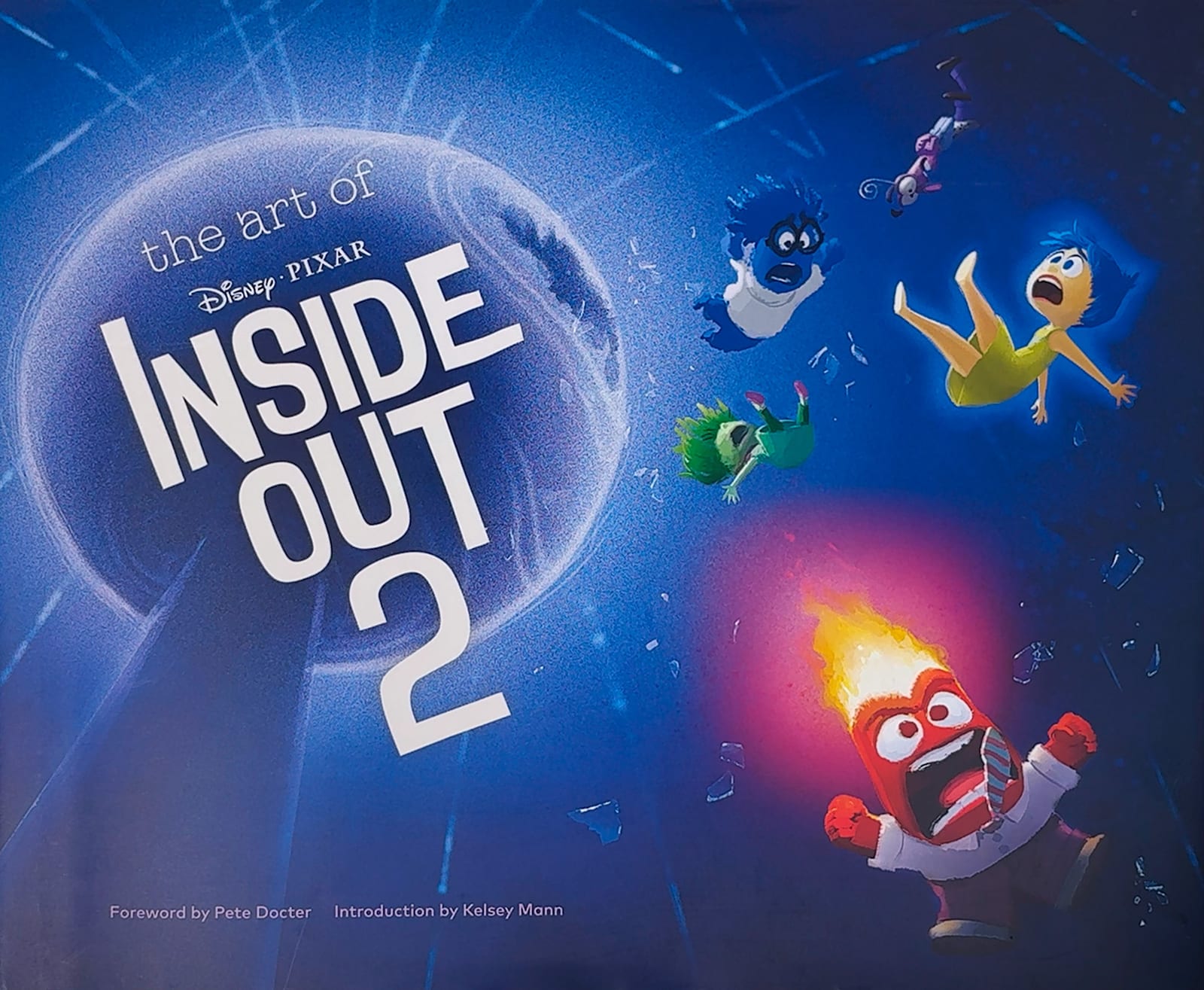
About the book
Riley is thirteen now, and her head has new tenants. Inside Out 2 brought in Anxiety, Envy, Embarrassment and Ennui, and The Art of Inside Out 2 is the book about how Pixar figured out what those feelings look like when you have to draw them.
It's put together around director Kelsey Mann's own account of the film, with a foreword by Pete Docter — who directed the first one and is now Pixar's chief creative officer — and work from more than fifty artists, including production designers Jason Deamer and John Hoffman, story supervisor Bill Zahn, and character artists Deanna Marsigliese and Keiko Murayama.
First impressions
It’s a Chronicle Books “Art of” through and through: same 11 × 9 landscape format, same clean layout, same confident printing. Nothing about the object surprises you, and honestly that’s fine — the format works. What does surprise you is how much of the book is about ideas that got thrown away, which is not usually where these books spend their pages.
Content
Disney/Pixar The Art of Inside Out 2. 160 pages, hardcover, Chronicle Books, by Kelsey Mann with a foreword by Pete Docter. Released May 14, 2024, a month before the film.
Characters
This is the reason to buy the book, and it’s worth being specific about why.
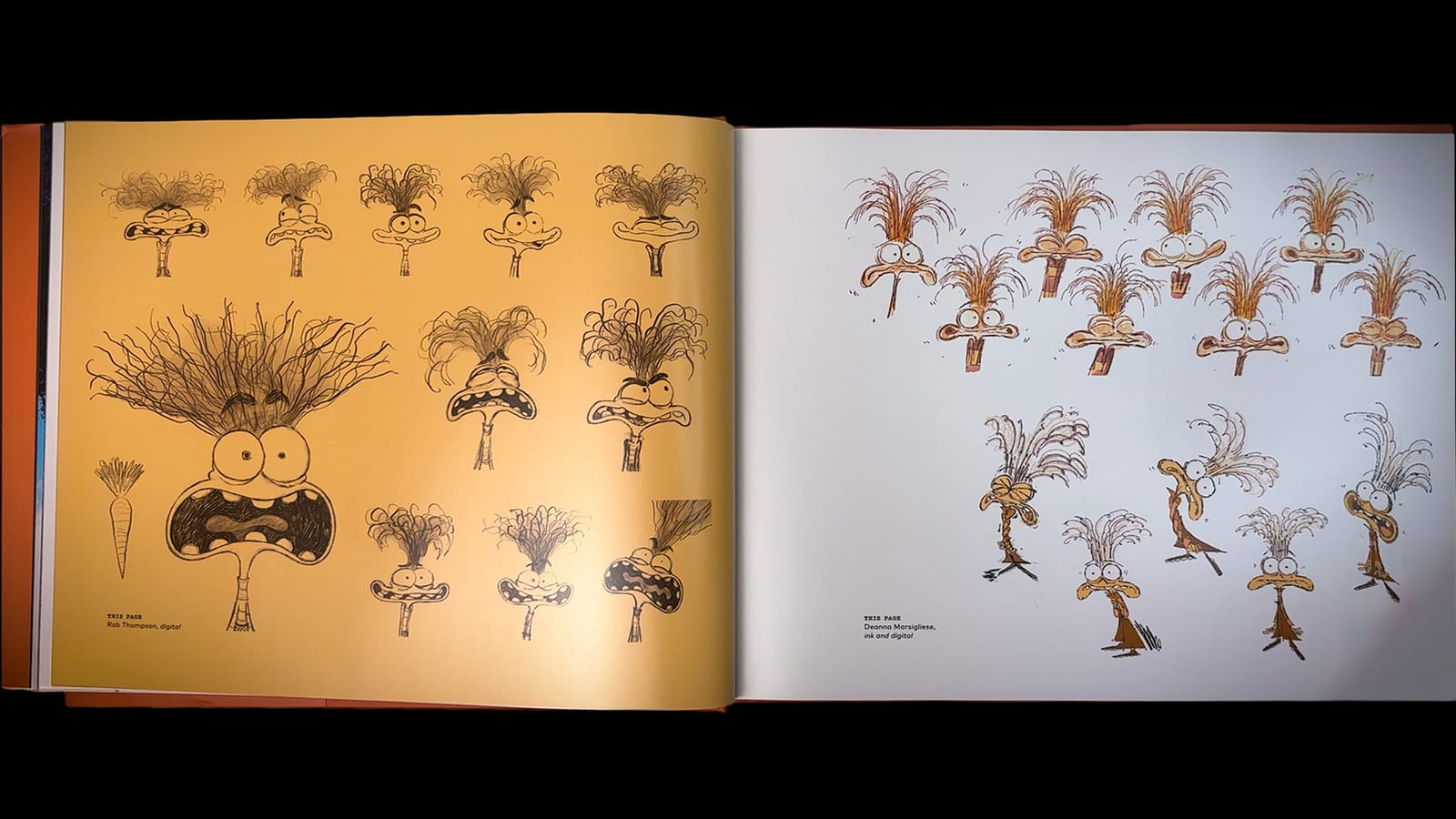
Mann didn’t start with four new emotions. He started with nine, and after the first internal screening the note that came back was one word: simplify. Both Joy and the audience were drowning. So five characters got cut — and the book prints their concept art anyway.
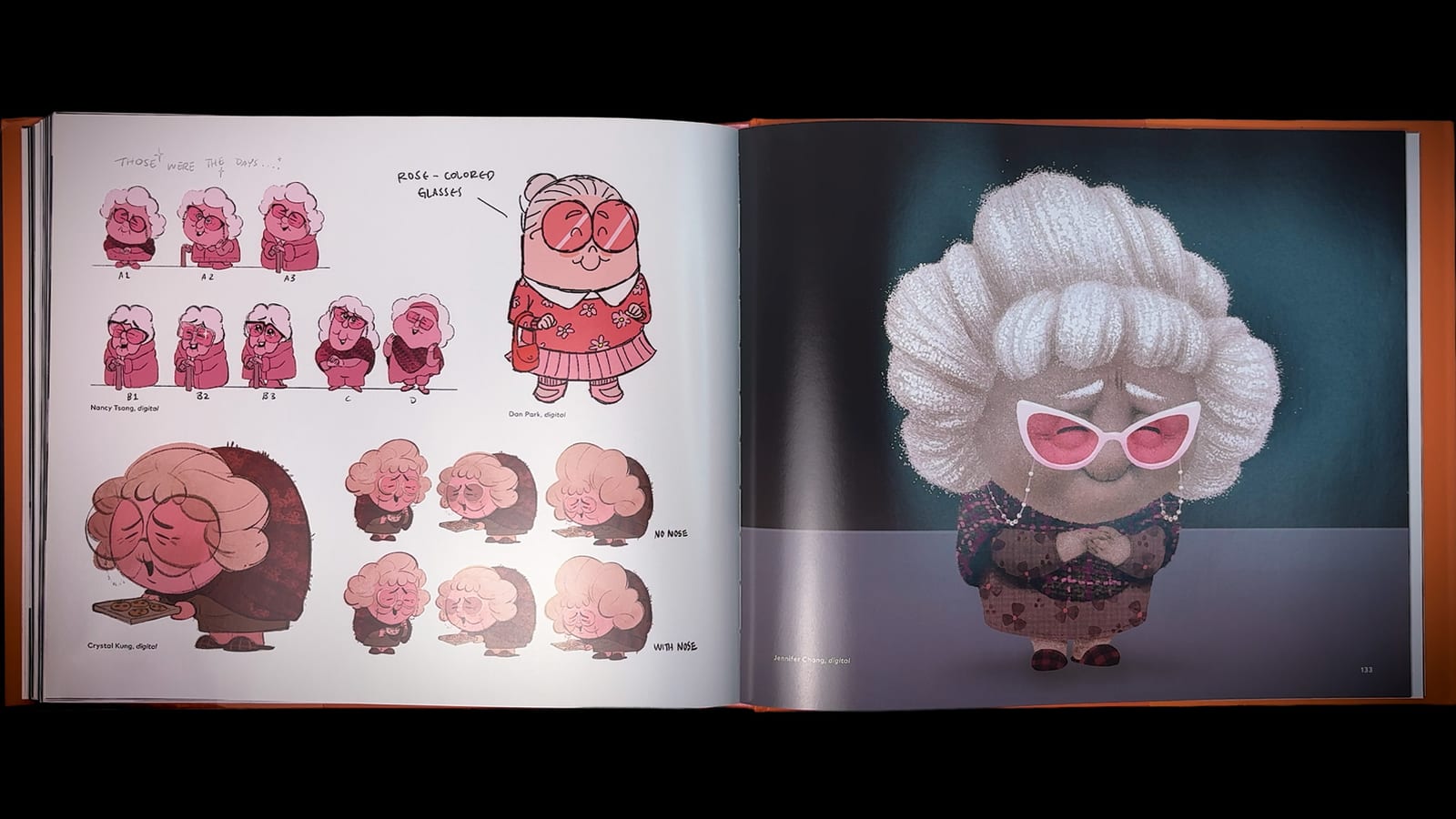
You get Shame, a dark blue figure. Guilt, whose original visual gag was a giant hotel luggage cart piled with baggage — an idea that didn’t die, it just moved over to Anxiety and became her suitcases. Jealousy, in several passes. Awe. Nostalgia, drawn as a kindly old woman. And Schadenfreude, which is the deepest cut of all: Pete Docter had originally sketched that one for the first movie, back in 2015. It’s been waiting in a drawer for nine years and still didn’t get in.
Anxiety is the design story the book keeps circling. She started out more monstrous, and it didn’t ring true — nobody on the crew experienced their own anxiety as a monster. Mann has said one early reference point was All About Eve, of all things: the smiling newcomer who takes over. The final version, with the enormous toothy grin and the bulging eyes, is the one Mann calls his favourite precisely because it was the hardest to land, and he credits Jason Deamer for pushing her as far graphically as Fear had been pushed in the first film. As screenwriter Meg LeFauve put it, Anxiety “has a good goal but a bad plan” — which is a very generous and very accurate description of how anxiety actually behaves.
Ennui was the opposite: she showed up almost instantly. Story artist Dan Park drew her as a wet noodle, boneless and gravity-defeated, and that was it, done. There’s a lovely detail behind her attitude, too — while Mann and producer Mark Nielsen were in Paris recording Adèle Exarchopoulos, they spotted a teenager on the street wearing a shirt that said I DON’T CARE. That’s the whole character.
The journey through the story
The book follows the production roughly in order — story sketches, character passes, colour scripts, final frames — and Mann’s introduction gives it a spine. He traces the film back to a stack of his own childhood photographs, where he noticed his smile getting smaller and more self-conscious between ages five and thirteen. That’s the entire premise of the movie, and it came from a shoebox.
There’s also research underneath it: Pixar worked with Berkeley psychologist Dacher Keltner, who pointed them toward self-conscious emotions and social comparison as the feelings that really arrive with puberty. That’s why the new four are what they are — they’re not just “more emotions”, they’re specifically the ones that only show up once you start caring what other people think of you.
The worlds
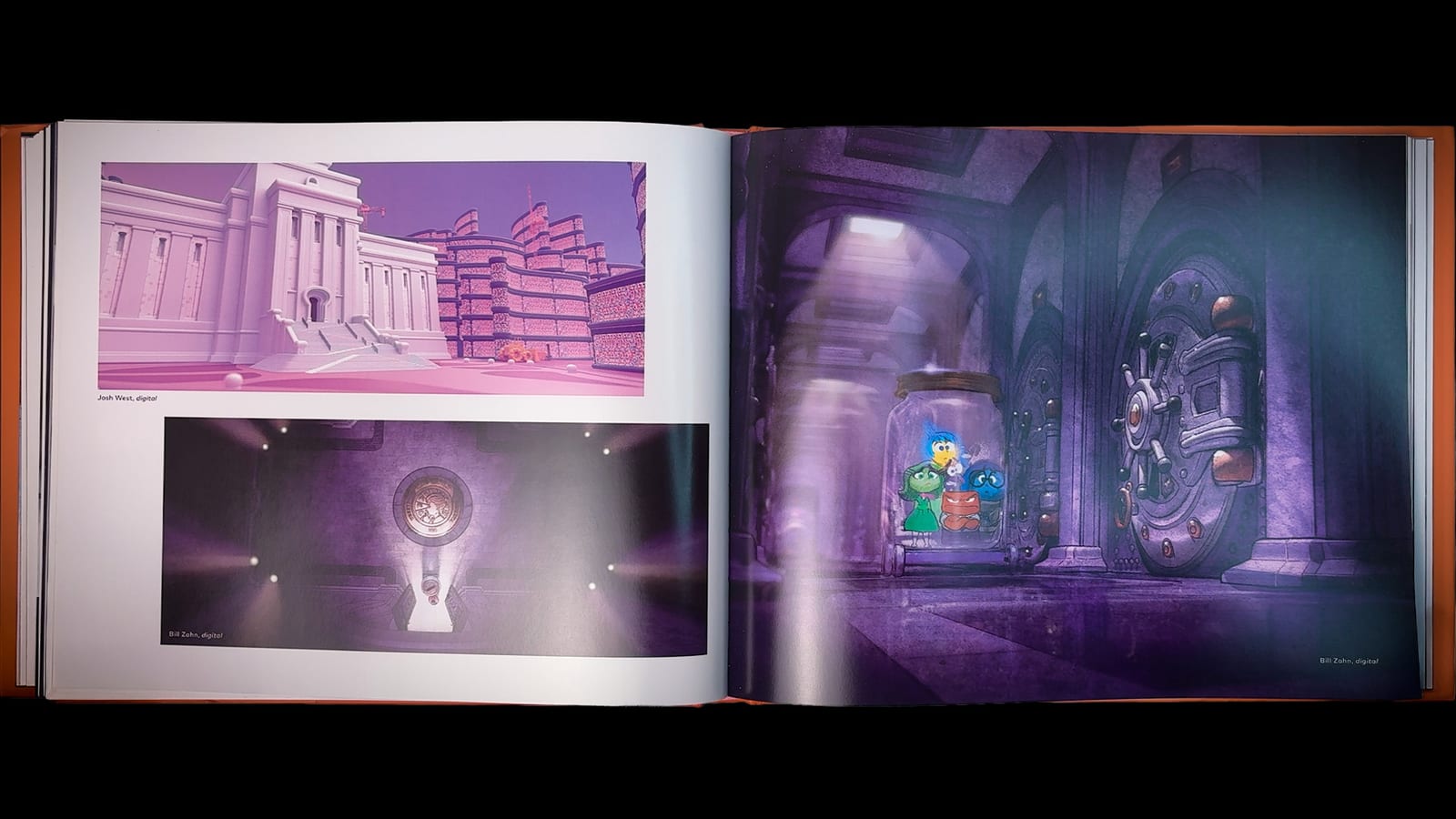
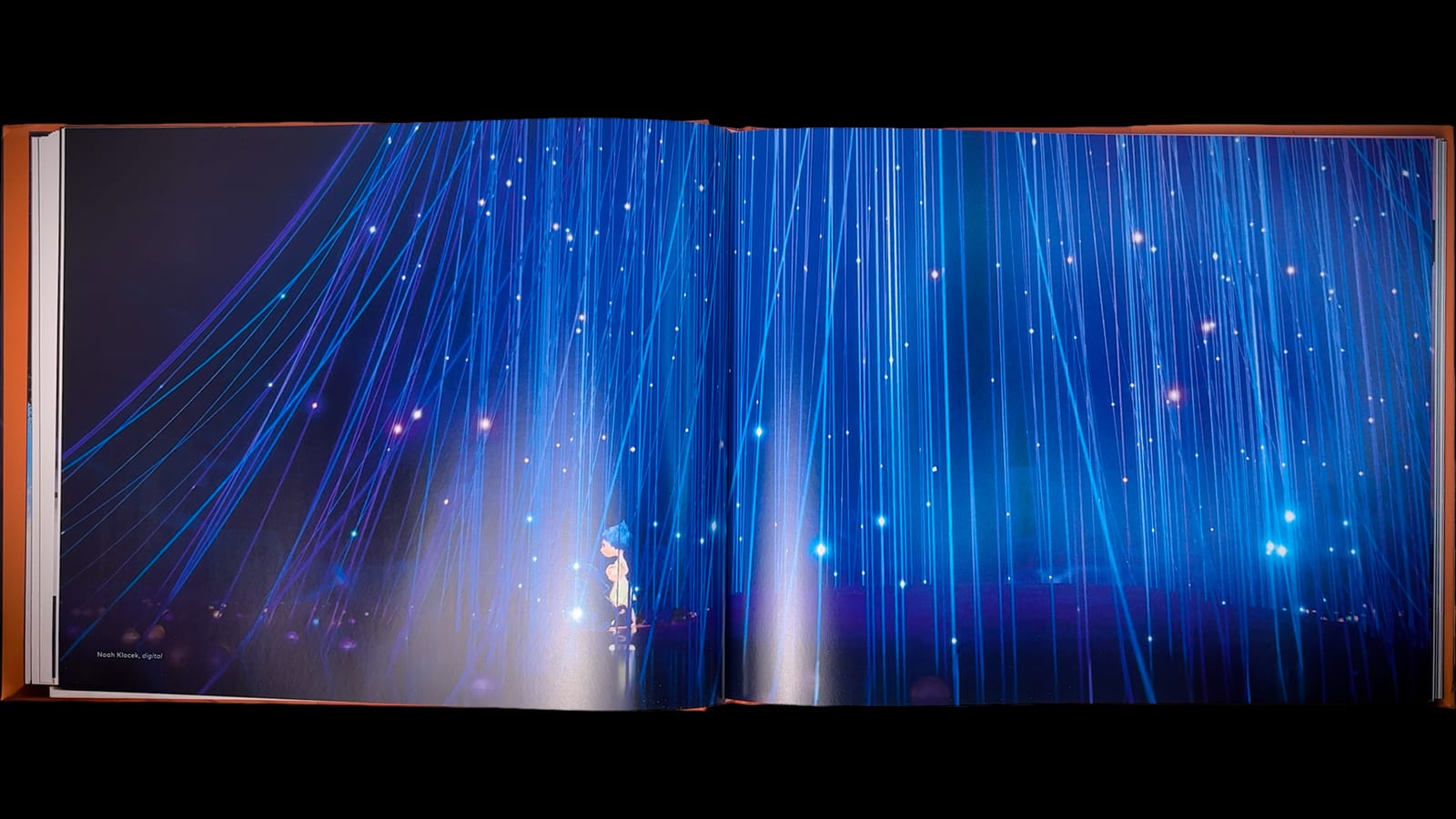
The new geography of Riley’s mind gets solid coverage: the Belief System with its glowing strands, the Sense of Self, the Back of the Mind where forgotten things get shoved, plus Anxiety’s imagination sweatshop. The emotions themselves still follow the first film’s rule — they’re made of energy, not skin, so everyone has a faint fizz of particles at the edges, with Anger the most solid and Joy the most effervescent. Seeing that logic extended to four new bodies is one of the quieter pleasures here.
What’s inside
The book moves through the production as a whole:
- New emotions — design iterations for Anxiety, Envy, Embarrassment and Ennui, plus the ones that were cut.
- Returning cast — how Joy, Sadness, Anger, Fear and Disgust were adjusted for a teenage Riley.
- Environments — the Belief System, Sense of Self, the Back of the Mind.
- Color scripts & storyboards — the emotional mapping of the film, sequence by sequence.
The cut-emotion concept art is the material you won’t find anywhere else, and it’s the strongest argument for the book.
The artwork
The art is lovely and the reproduction is clean — no complaints there. But I’d be doing you a disservice not to mention the thing readers keep flagging: the text is thin. It sits at 4.25 stars on Goodreads, and the recurring note in the reviews is some version of “I missed the paragraphs explaining how it was made, like the older Art of books had.” Several people call it a bit by-the-numbers.
I think that’s a fair hit. Chronicle’s Pixar books used to carry real artist commentary — why a shape was chosen, what got argued about — and this one leans more toward gallery than explanation. The stories that are here (the nine emotions, the luggage cart, the wet noodle) are great, which almost makes it worse: you can feel how much more there was to tell.
Video Preview
New artbook videos every week
Subscribe for more animation and concept art content.
▶ Subscribe on YouTubeIs it worth it?
If you liked the film and you want to see the versions of it that don’t exist, yes. The cut emotions alone justify it, and the Anxiety design progression is a genuinely useful case study if you draw characters yourself.
If you’re building a reference library and you want the deep making-of text, temper your expectations — this is an art book that’s a little light on the “art of.”
Verdict: gorgeous, generous with its rejected ideas, thinner than it should be on commentary. Worth it for the Anxiety pages and the five emotions that never made it out of development.
Value
List price is $42.50 / CA$57 / £35 / €40 — standard for a 160-page Pixar hardcover at this size. It’s been out since 2024, so it turns up discounted fairly often; there’s no reason to pay full price if you’re patient.
If you decide to pick it up, the links at the end of this post are affiliate links. It costs you nothing extra and it helps keep this channel going.
📚 Want this book? Grab your copy:
As an affiliate, we may earn a small commission from qualifying purchases — at no extra cost to you.
Watch the film on Disney+