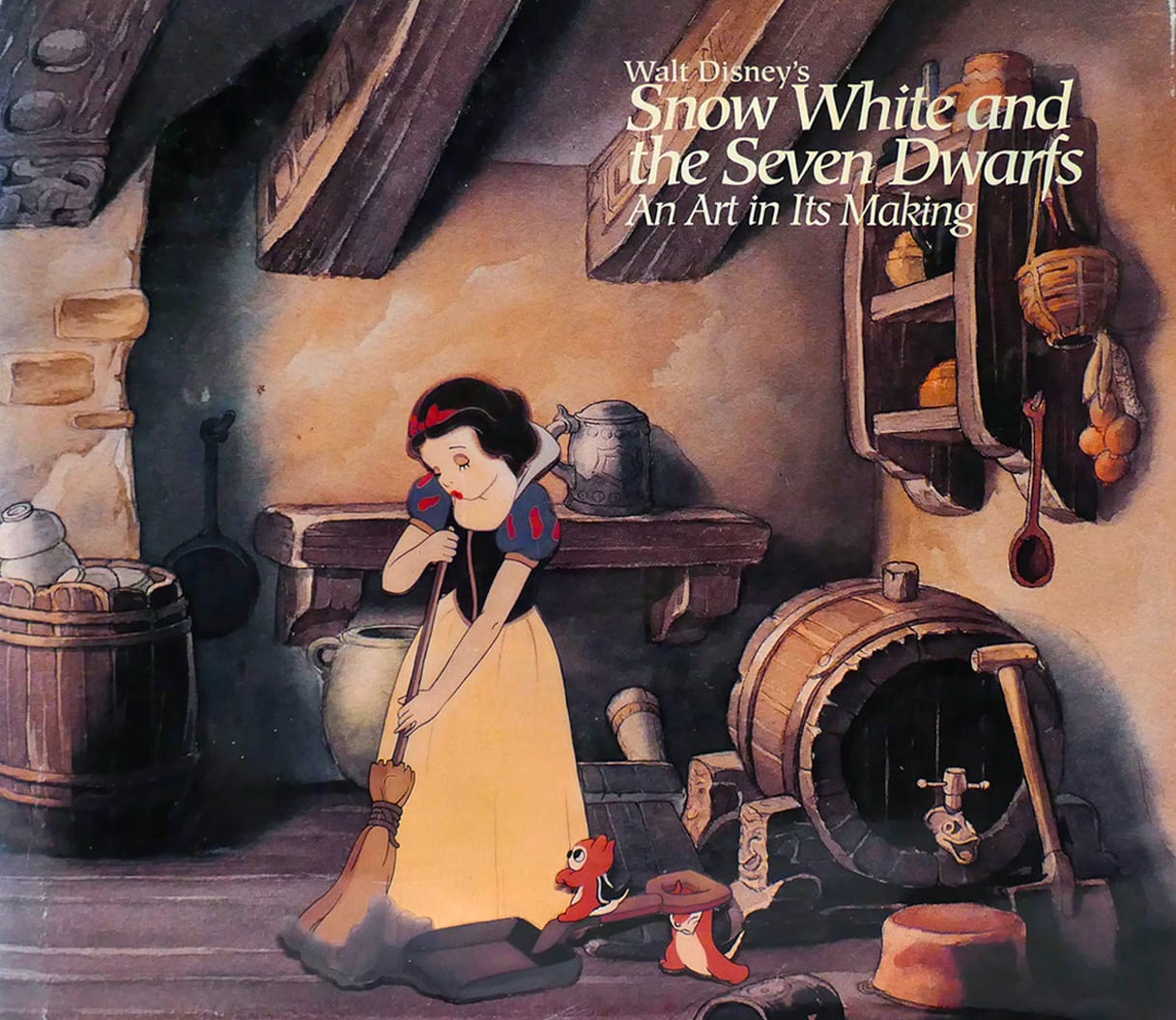
About the book
Every artbook on your shelf owes something to this film. Before Snow White and the Seven Dwarfs, nobody had made a feature-length animated movie — the industry literally called it "Disney's Folly" while it was in production. Walt bet the studio on it, and when it premiered at the Carthay Circle Theatre in December 1937, it didn't just work: it invented the whole category.
Walt Disney's Snow White and the Seven Dwarfs: An Art in Its Making came out in 1994 as the companion to an exhibition at the Indianapolis Museum of Art, built around the private collection of Stephen H. Ison — master backgrounds, concept art, cels, production drawings, studio notes and character model sheets, most of it never publicly shown before. Martin Krause curated it; Linda Witkowski, a conservator, wrote about what it actually takes to keep sixty-year-old watercolor and celluloid alive. That combination is what makes this book different from the ones that came after it.
First impressions
This is a 1994 book and it feels like one, in the best sense. Big square-ish format, generous margins, and a design that gets out of the way instead of decorating. There’s no attempt to make it look like a modern artbook — it looks like what it is, a museum catalogue, and it carries itself with that seriousness.
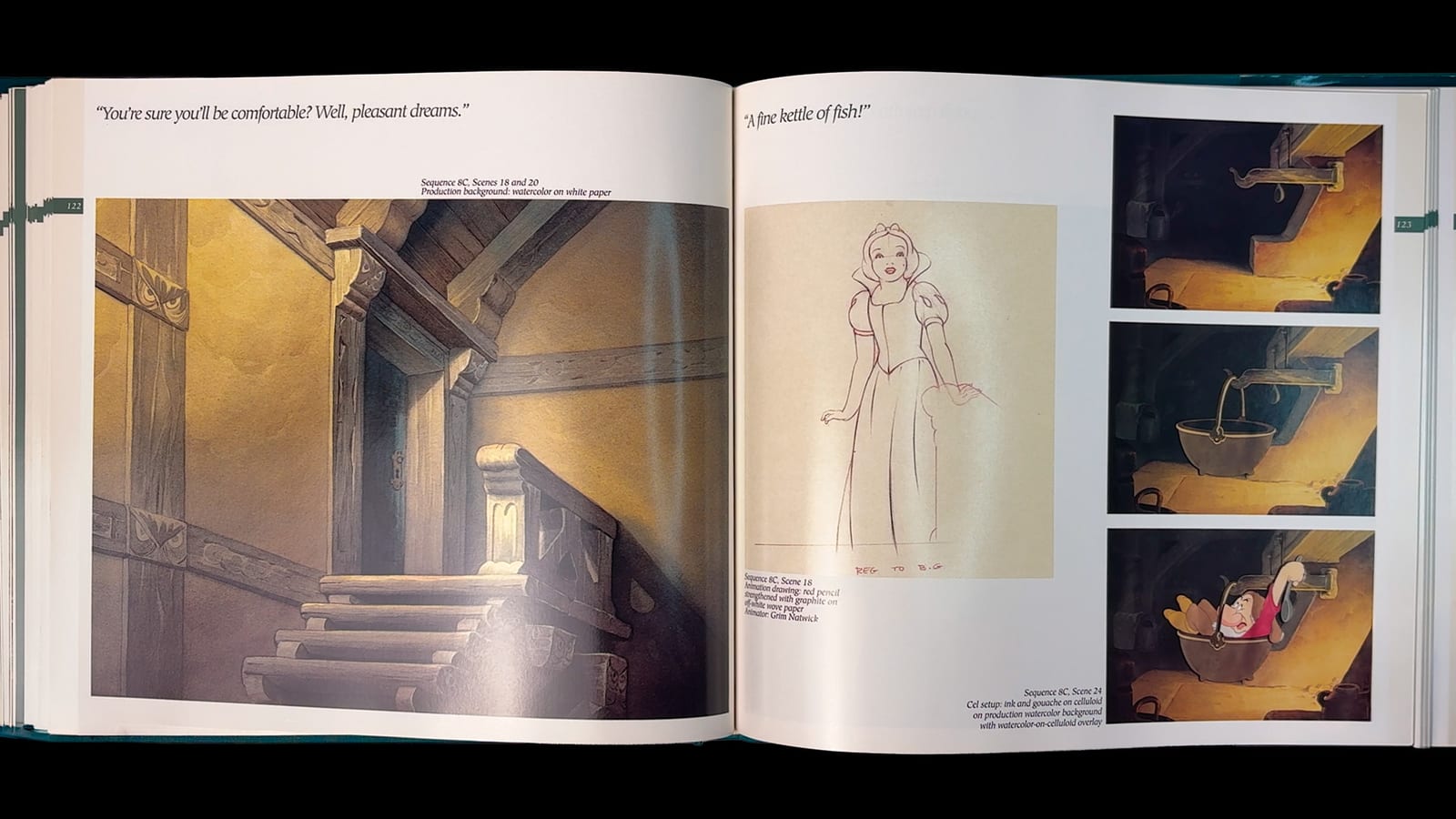
The reproduction is careful with material that was already sixty years old when this was printed: faded graphite, yellowed cels, watercolor backgrounds that were never meant to survive at all. Nothing has been over-corrected into looking new, which I appreciated. You can see the age of the paper, and that’s part of what you’re looking at.
Content
Walt Disney’s Snow White and the Seven Dwarfs: An Art in Its Making — Featuring the Collection of Stephen H. Ison. 192 pages, hardcover, Hyperion with the Indianapolis Museum of Art, by Martin Krause and Linda Witkowski. Published September 23, 1994.
A pocket-sized Disney Miniature Edition followed in 1995 with the same content at a much smaller trim, and the subject was picked up again in 2012 with a new companion volume for the film’s 75th anniversary — but the 1994 edition is the original, and the one built directly on the Ison collection.
Characters
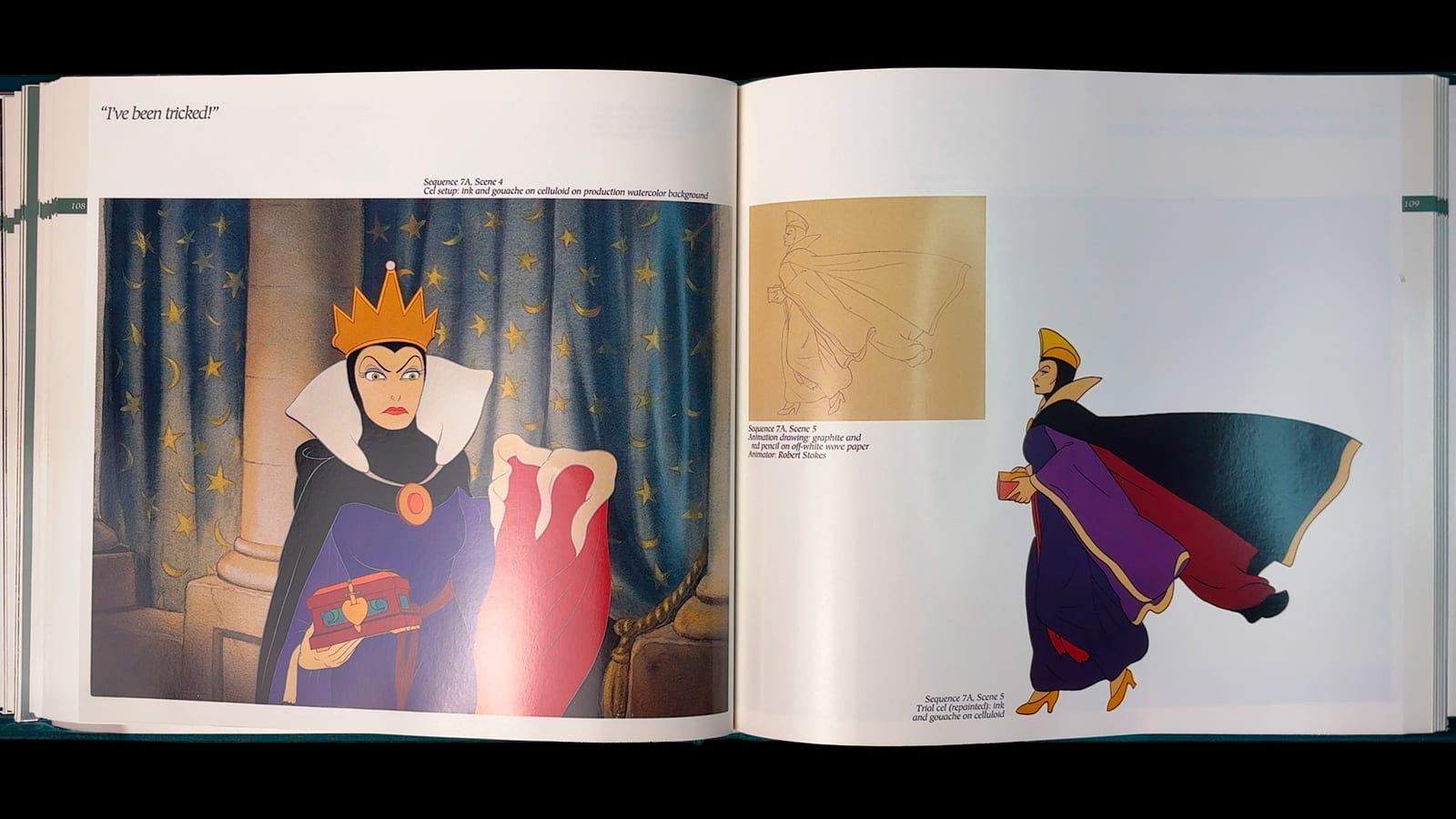
The character material here comes from the studio’s own working documents rather than from a curated “greatest hits” selection, and that changes what you see. Model sheets with correction notes still on them. Pencil drawings where the animator is clearly still hunting for the pose. The Queen and the Witch go through faces that are stranger and harsher than what made it to screen.
There’s real context around who drew what, too. Walt hired Don Graham to run a full-time art school inside the studio and set him the task of finding three hundred artists who could actually draw — classes in line work and life study, with live models and live animals brought in. By the end, around 750 people had worked on the film. At the time it was the largest collaborative art project ever attempted in the United States, and the drawings in this book are the physical evidence of that scale.
The journey through the story
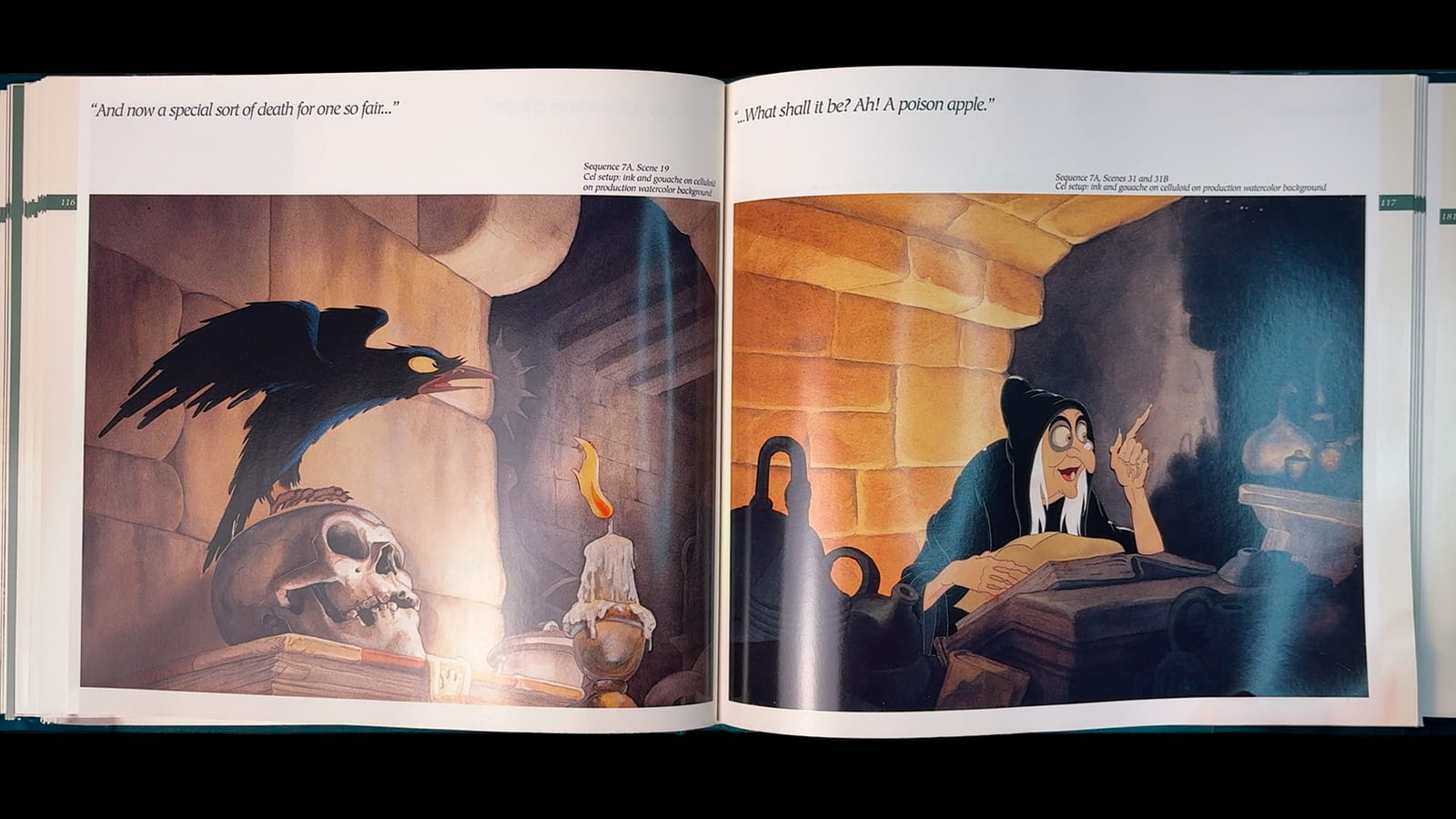
The book walks the film scene by scene rather than sorting things into “characters” and “backgrounds” chapters. Cel setups, layouts and pencil drawings appear where they belong in the story, so you’re essentially rewatching the movie through its own production paperwork.
Where it gets genuinely gripping is the production history running alongside. The money nearly ran out in 1937, and Walt ended up screening a half-finished cut — rough pencil tests, missing sequences, no color in places — for Joe Rosenberg of Bank of America, hoping for more credit. Rosenberg watched the whole thing without saying much, walked out to his car, and only then remarked that the picture was going to make a pot full of money. It did: ten million dollars in 1938 alone.
The worlds
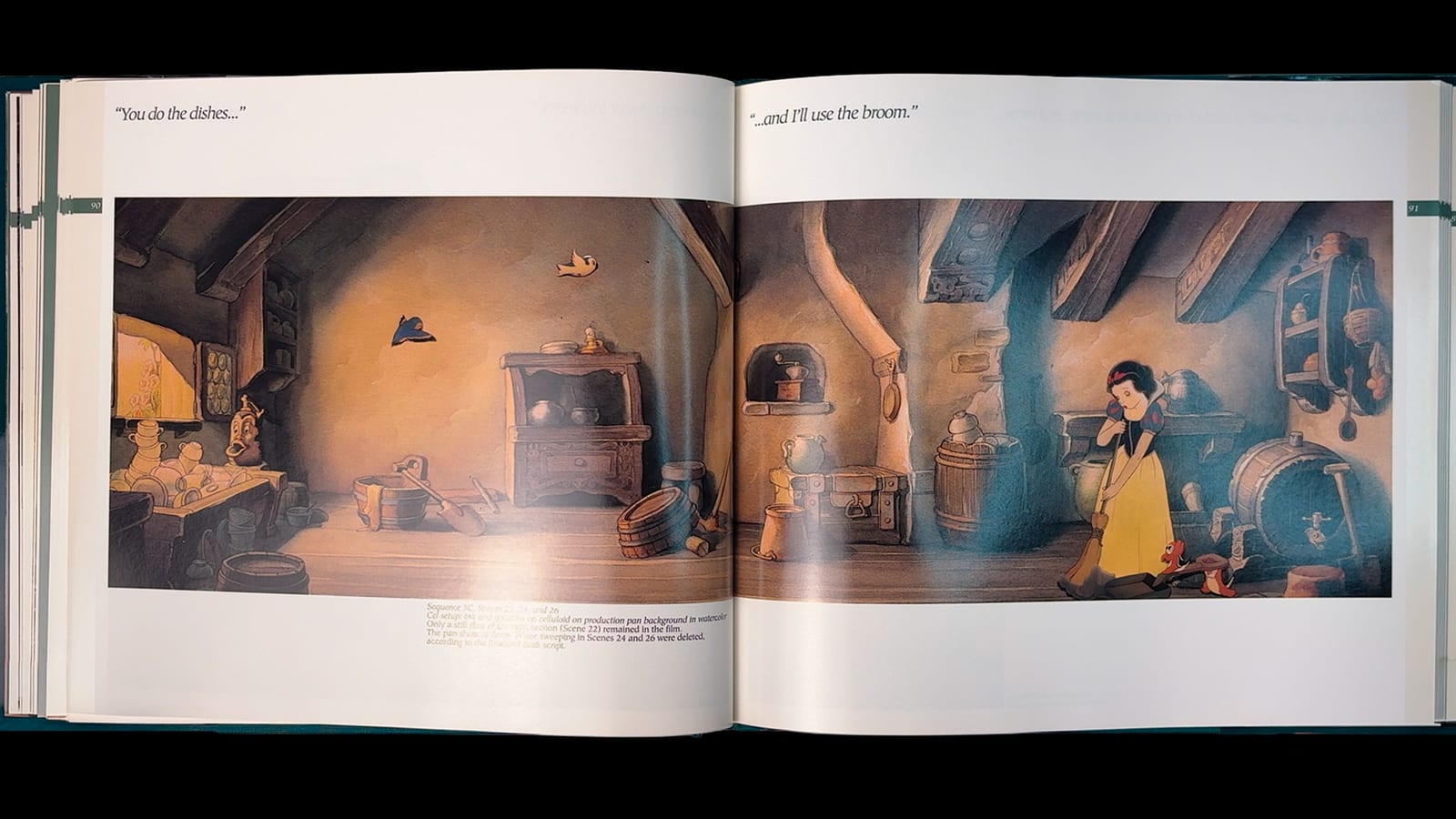
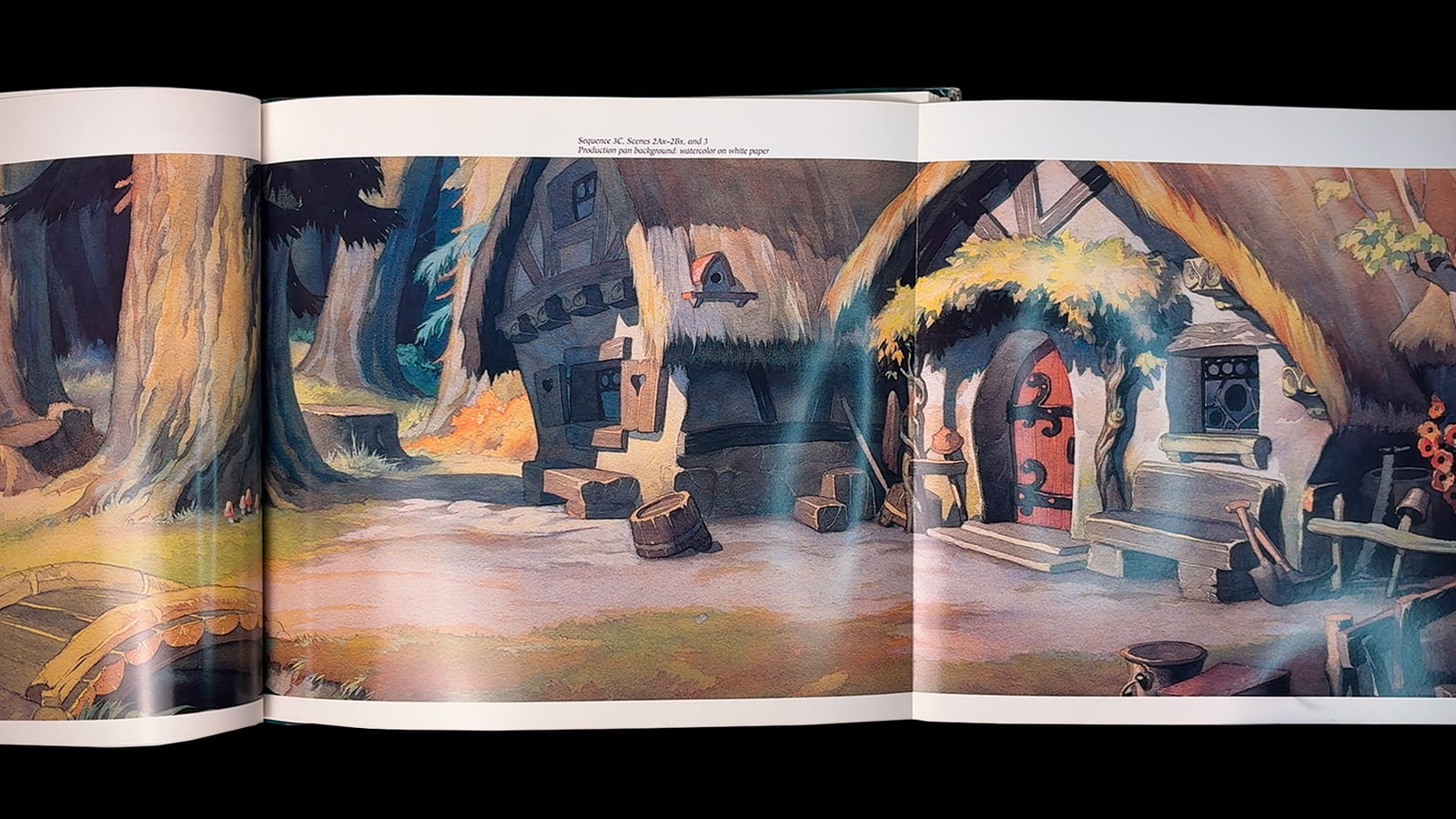
The backgrounds are the heart of this book, and it’s the section that most rewards slow reading. Roughly 729 separate backgrounds were painted for the film, in watercolor on specially prepared paper, and Krause and Witkowski explain the workflow properly: thumbnail color sketches first, then preliminary studies, then the final painting registered precisely to the layout. Artists often had up to five backgrounds going at once just to keep the color continuous across a sequence.
And here’s the detail that stuck with me — watercolor doesn’t forgive. You can’t lift it once it’s down. So when animation changed, finished background paintings were simply thrown out and repainted from scratch. Knowing that, the forest and the cottage interior read differently.
Witkowski’s conservation chapter is the part almost no other artbook has. How cels warp and yellow, how nitrate-era materials degrade, what restoring a sixty-year-old background actually involves. If you care about original animation art as objects rather than just images, this is the reason to own this specific book.
What’s inside
The book runs as a tour through the production and its afterlife:
- Concept & development art — the earliest visual ideas, from 1934 onward.
- Character studies — model sheets, pencil drawings and discarded versions of Snow White, the Queen and the dwarfs.
- Background paintings — the watercolor environments from the Ison collection, reproduced large.
- Conservation & restoration — what it takes to keep this material alive, written by the conservator who did it.
For anyone who loves animation history, this is the one that treats the art as art — with a bibliography and an index to match.
The artwork
The reproduction quality is the reason this book still trades secondhand at healthy prices. These are large, clean plates of material that mostly hadn’t been published before 1994 and, in a lot of cases, still hasn’t been reprinted anywhere else.
The fair criticism — and I think it’s fair — is that the writing is lighter than the format promises. Readers who come looking for a deep scene-by-scene production history sometimes find the text a bit thin next to the images. It’s a museum catalogue, not a full making-of, and it behaves like one. If you want the exhaustive narrative version, that’s what the later books are for. What this one gives you is the objects.
Video Preview
New artbook videos every week
Subscribe for more animation and concept art content.
▶ Subscribe on YouTubeIs it worth it?
If you’re a collector, yes, without hesitation — this is a piece of the history it documents. It came out at the moment when animation art was being taken seriously as museum material, following the path that started with the Los Angeles County Museum’s Disney retrospective back in 1940, when the critic Dorothy Grafly called animation “probably the first genuinely American art since that of the indigenous Indian.”
If you’re mainly after a thorough written account of how the film got made, know going in that this is a book of images with supporting text, not the other way around.
Verdict: the original art book on the first animated feature, and still the one with the best conservation material in it. Out of print, worth hunting.
Value
It’s been out of print for years, so prices swing a lot depending on where you look — right now secondhand listings run around $18 / CA$12 / £45 / €16, though that shifts constantly with condition and availability. The 1995 Disney Miniature Edition is much cheaper and has the same content, but at that trim size you lose exactly what makes the backgrounds worth looking at. Get the full-size 1994 edition if you can.
If you decide to pick it up, the links at the end of this post are affiliate links. It costs you nothing extra and it helps keep this channel going.
📚 Want this book? Grab your copy:
As an affiliate, we may earn a small commission from qualifying purchases — at no extra cost to you.
Watch the film on Disney+