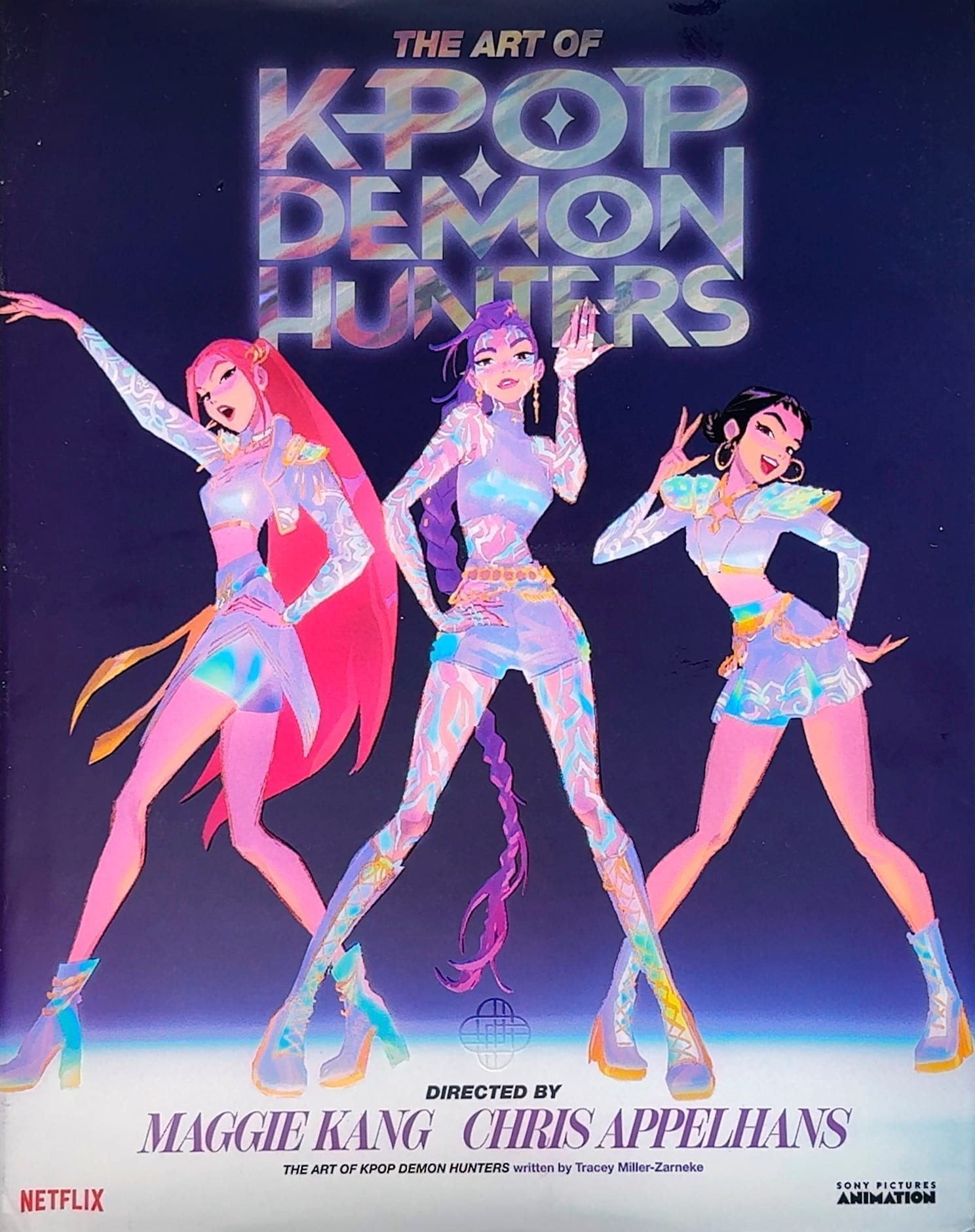
About the book
I don't think any animated film in recent memory has taken over the world quite like KPop Demon Hunters. It came out on Netflix in June 2025, fairly quietly — and within a few months it had become Netflix's most-watched original title ever, passing Red Notice and then Squid Game's first season. "Golden" sat at number one long enough to become the longest-running Hot 100 chart-topper by a fictional act. And in March 2026 it won two Oscars: Best Animated Feature and Best Original Song. "Golden" became the first K-pop song ever to win an Academy Award.
So, yes. An artbook was inevitable. What wasn't inevitable is how it arrived — because the first version of The Art of KPop Demon Hunters was released completely free, online, for anyone to read.
Read it free online
This is the part I want everyone to know before anything else: you can read the whole book right now at theartofkpopdemonhunters.com.
Netflix and Nucleus put it up in late November 2025 — 142 pages, split into 18 chapters, with side-scrolling pages and the soundtrack playing while you read. It’s one of the nicest ideas I’ve seen from a studio in a long time. Most “art of” books are a $40–50 gamble; this one lets you look at every page before you decide whether you want it on your shelf.
And honestly? Reading it online is exactly what made me want the physical copy.
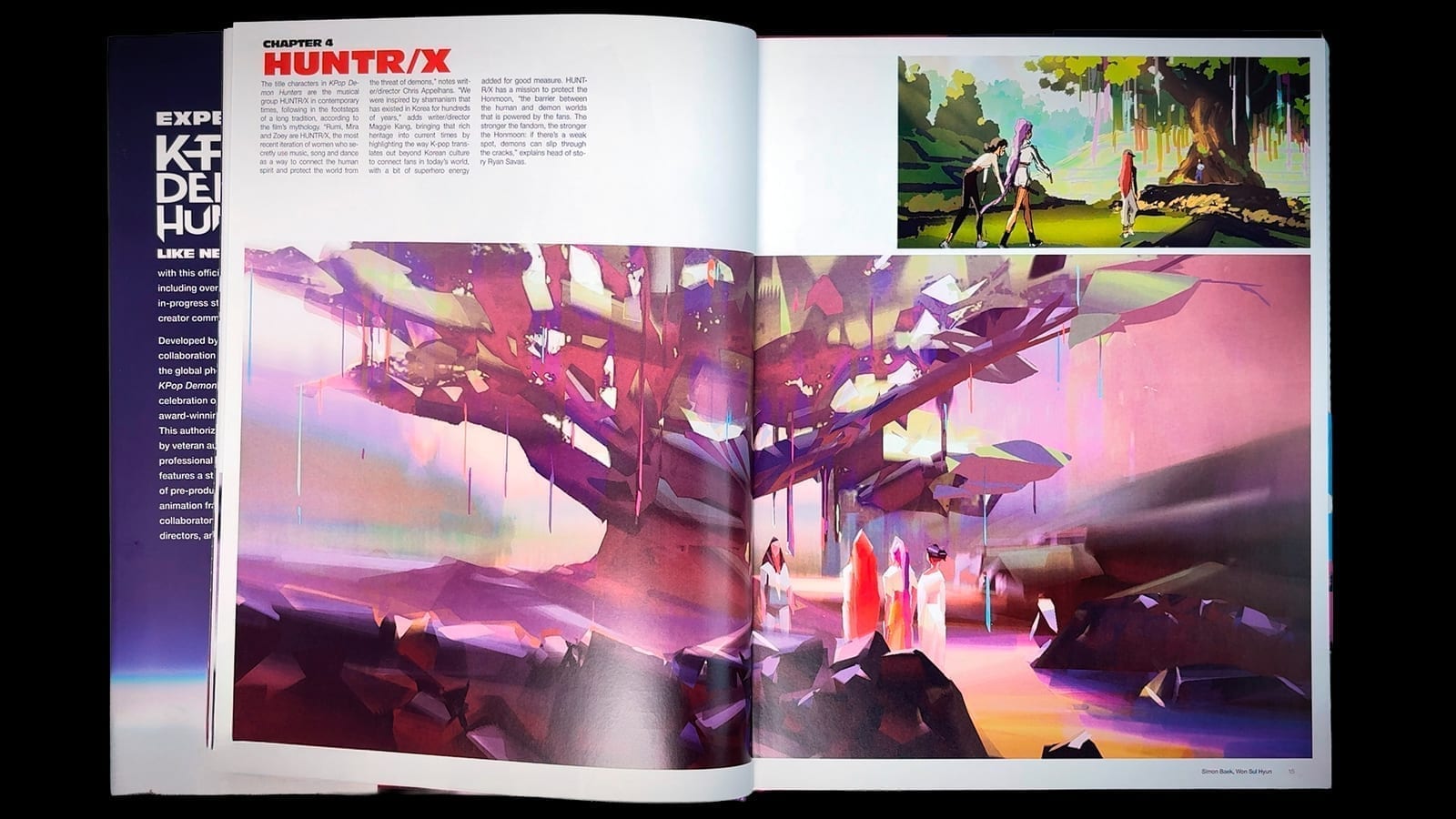
First impressions
The first thing you notice is that it doesn’t behave like a normal artbook, and that’s on purpose. Nucleus describes their edition as “not a traditional art book” — it’s built like a mook, the magazine-book hybrid that K-pop fan culture is full of. There are fun facts, mini-interviews, character profiles, choreography breakdowns, even a page on the in-flight menu from the plane scene. It reads less like a museum catalogue and more like the fan book HUNTR/X would actually have.
If you’re used to big landscape hardcovers full of quiet environment paintings, this will feel loud. But it’s loud in the same way the movie is, and I think that’s the right call.
Content
The Art of KPop Demon Hunters exists in three versions:
- Free digital edition — 142 pages, 18 chapters, released November 2025 at theartofkpopdemonhunters.com.
- Nucleus softcover — 142 pages, 8.5 × 11 in, published by Nucleus with Netflix. Preorders opened January 1, 2026 and it started shipping February 1. The first printing sold out.
- Platinum Edition hardcover — 144 pages, 8.5 × 11 in, Random House Worlds, written by Tracey Miller-Zarneke. Released September 8, 2026, with around 500 pieces of art, a holographic foil jacket, an illustrated case featuring Rumi and Jinu, and holographic “platinum” page edges meant to evoke the Honmoon.
Characters
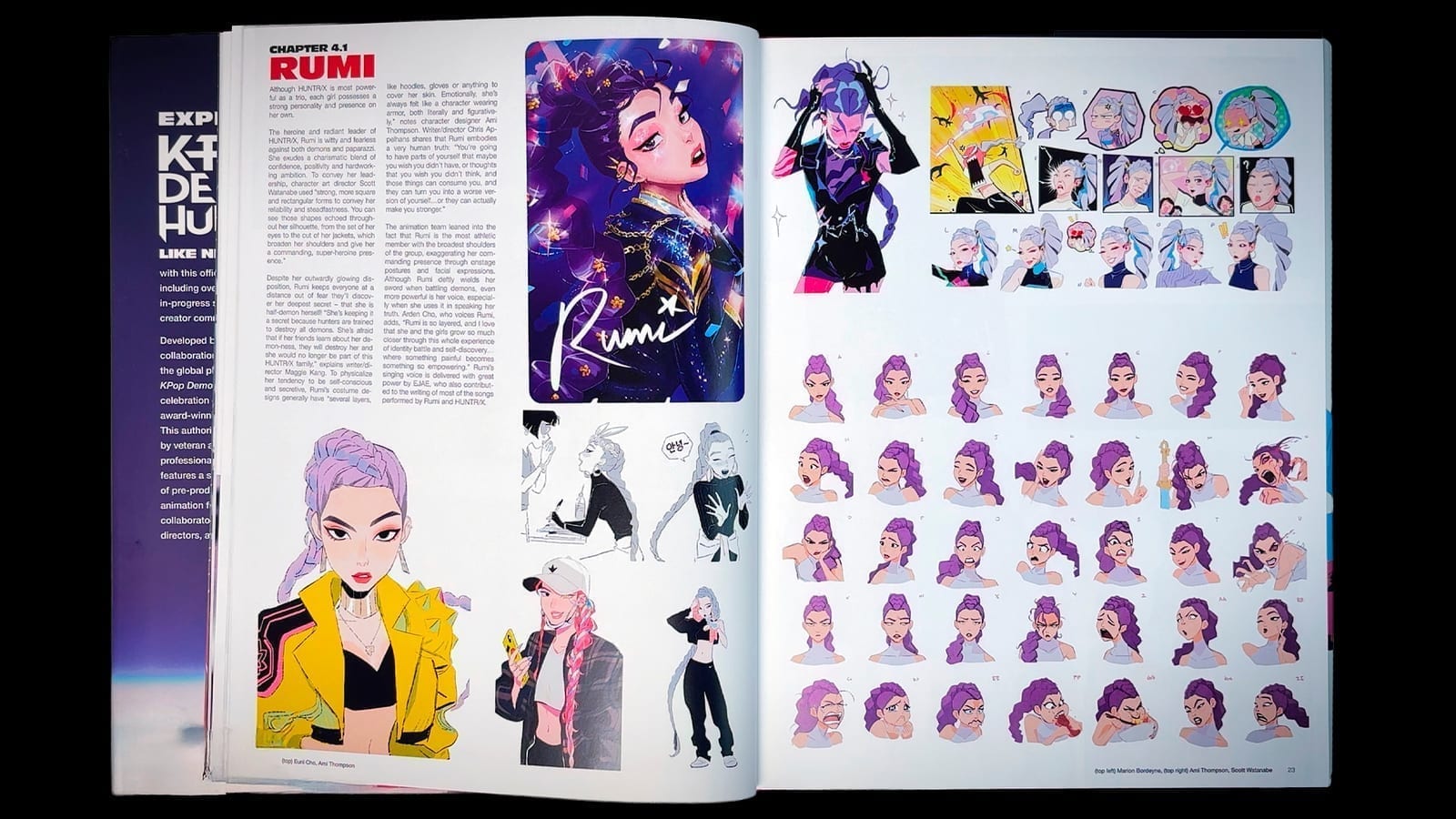
The character chapters are the heart of the book, and they’re full of the kind of thinking you don’t get from just watching the film.
Co-director Maggie Kang explains that the idea of demon hunters grew out of the grim reaper figure she remembered from her childhood, and that she wanted female superheroes who felt relatable — with real insecurities, not just cool outfits. Co-director Chris Appelhans has a lovely line about Rumi: everyone has parts of themselves they wish they didn’t have, and those parts can either wear you down or make you stronger. That’s the whole film in one sentence.
Jinu gets one of the most honest design write-ups I’ve read. Character designer Scott Watanabe talks about how hard it was to define “hot” for a demon while staying true to K-pop — he had to work as a rebellious bad boy and have a soda-pop cuteness at the same time. You can see that tension play out across his early sketches.
The Saja Boys are a design joke that keeps paying off once you know the reference. Jeoseung saja is the Korean grim reaper, and the traditional black gat hats they wear in “Your Idol” are a direct nod to how that figure is depicted in folklore.
And then there’s Derpy. The blue tiger was designed by story artist Radford Sechrist, who has said he’s “90% based on minhwa” — Korean folk painting — and about 10% based on the crew’s cat, Fluffy. The original folk-art tigers are grey; the bright blue came from production designer Helen Chen. Derpy and his magpie sidekick come from a genre of folk painting called jakhodo, where a goofy tiger and a magpie appear together. In the later satirical versions, the “idiot tiger” stood for the ruling aristocracy and the magpie, perched above him, for ordinary people — which makes Derpy’s whole goofy personality a centuries-old political joke. Oh, and the magpie has six eyes, three on each side. Sechrist confirmed it. You’ll never unsee it now.
The journey through the story
The book follows the film in order, from a short chapter on the project’s origins through each major sequence. Kang first pitched the idea to producer Aron Warner back in 2018; the film was announced in 2021, and production started that same year.
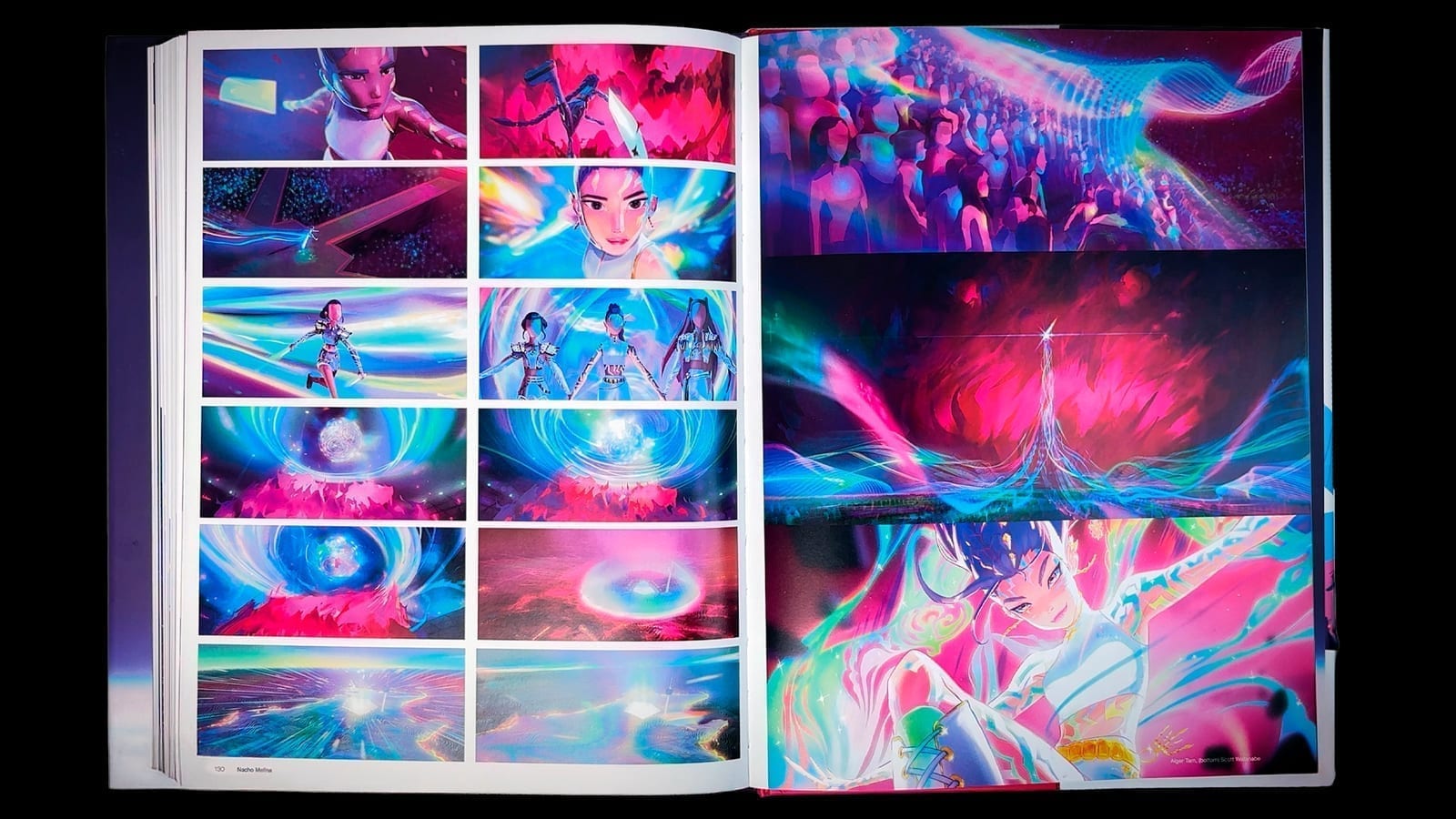
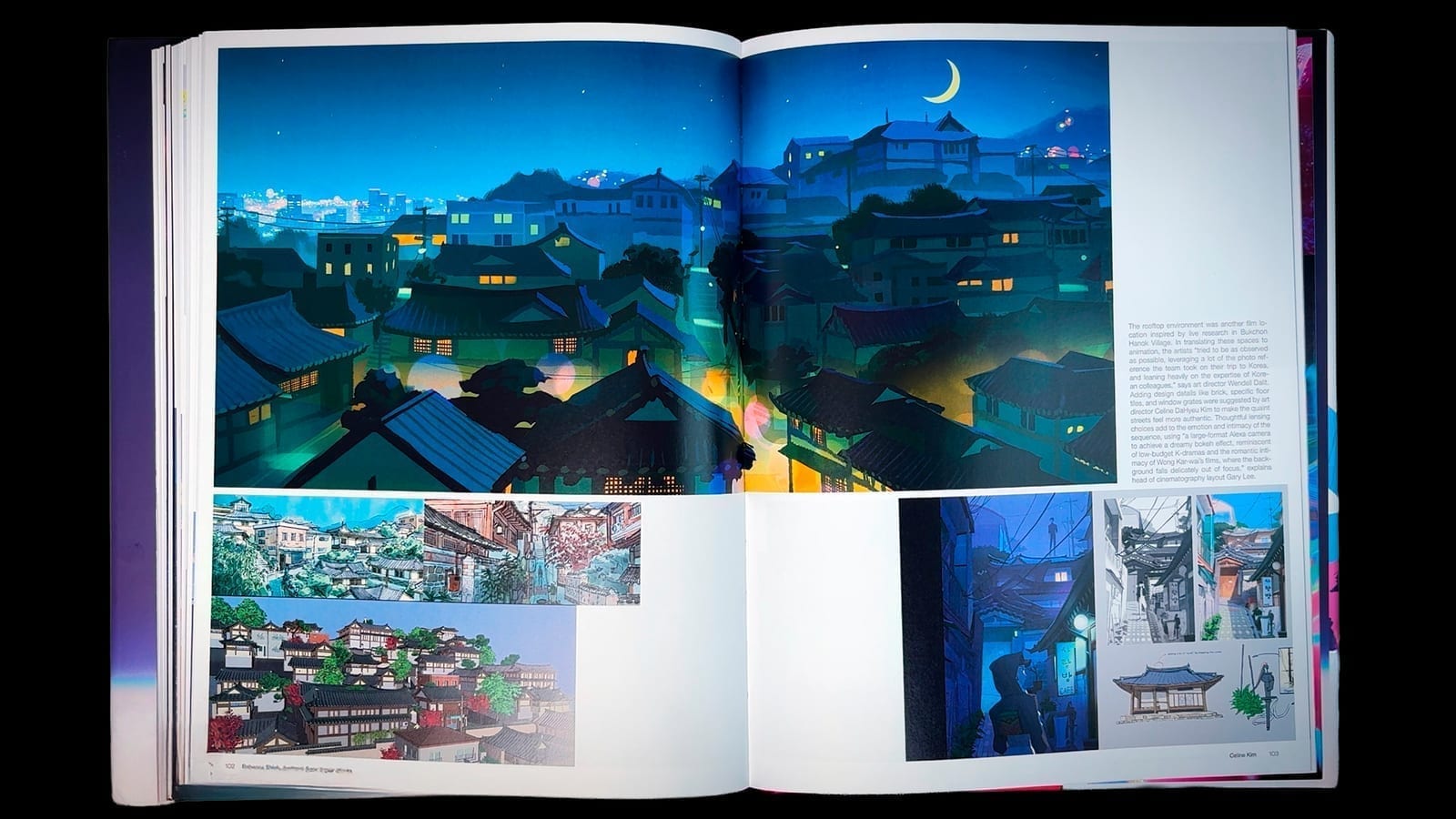
What I loved most here is the amount of unused material: gags that never made it, alternate staging, scenes that clearly went through several versions. The keyframes are especially good — you can see how a 2D painting set the colour, composition and mood of a shot long before anyone animated it.
There’s real cultural research underneath, too. Kang built the film’s mythology on Korean shamanism, especially the role of shaman women using song and dance in ritual — which is why the hunters fight with music in the first place. The Honmoon, the barrier their voices maintain, gets its own diagrams.
The worlds
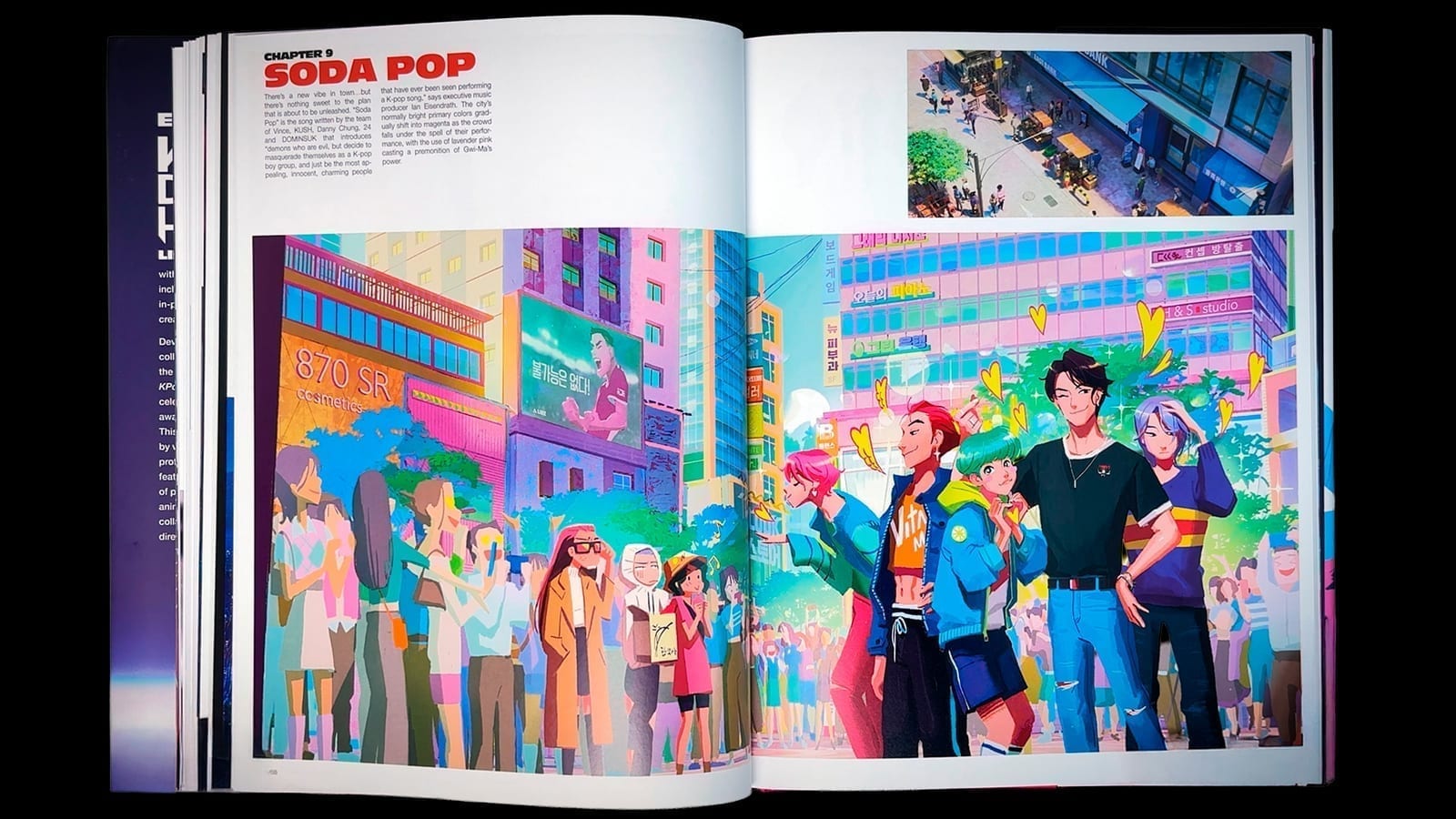
Seoul is a character, and the location work shows how carefully it was chosen: Namsan, the Naksan Park fortress trail, the hanok rooftops of Bukchon. Fans have literally started touring these places since the film came out.
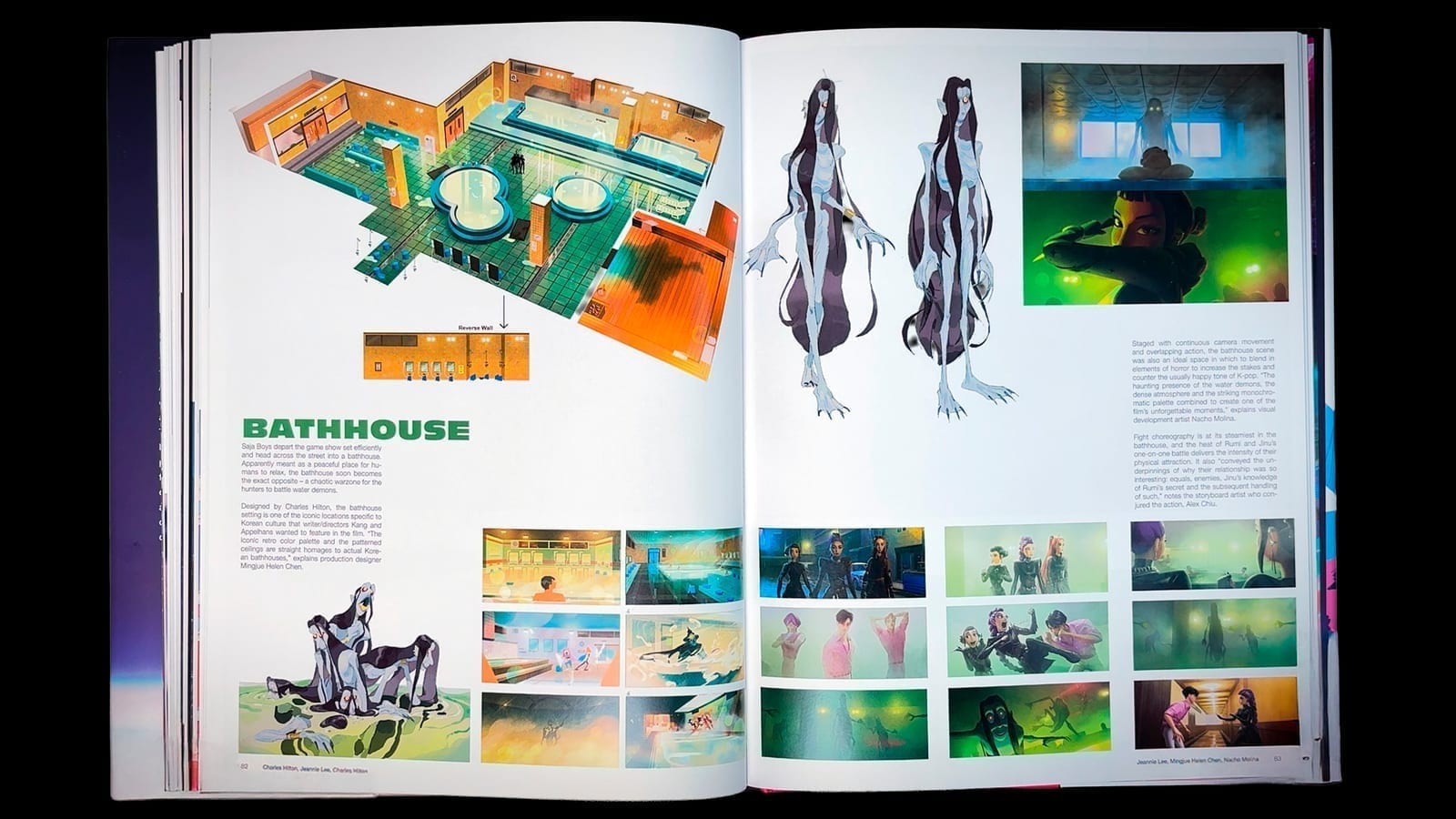
The bathhouse greens and the reds and pinks of the demon realm are some of the strongest colour work in the book. And the “Studio Snacks,” “Hair and Makeup” and “Looks that Slay” sections make clear just how much of this film lives in styling — the outfits, accessories and norigae charms got the same attention a fantasy film would give its armour.
On the technical side, the team pulled from music videos, concert lighting, editorial photography, K-dramas and anime. The Spider-Verse films were an influence, but they ended up going fully 3D, pushing the faces toward anime expressions — glamorous in the big triumphant moments, angular when someone’s angry, and full chibi for comedy. The sparkle in the fight scenes was inspired by the Korean action film The Villainess.
What’s inside
The book covers the whole production:
- Characters — HUNTR/X, the Saja Boys, Celine, Bobby, Derpy and Sussy, from first sketch to final look.
- Costumes, hair & makeup — the idol styling, stage outfits and norigae charms.
- Mythology — “Hunters through the Ages,” the Honmoon, and the shamanic roots of the story.
- Locations — Seoul streets, rooftops, the bathhouse and the demon realm.
- Keyframes & storyboards — colour, composition and plenty of unused moments.
- Extras — choreography breakdowns, fun facts, interviews, and a full credits and songs page.
The magpie has six eyes, three on each side. Sechrist confirmed it. You’ll never unsee it now.
The artwork
The art is gorgeous, and there’s a real range of styles: soft, textured pastel character concepts sitting right next to bold, almost abstract keyframes. The Platinum Edition prints it brightly, on clean mostly-white backgrounds that let the colour do the work.
Something I really appreciated: the book credits the whole crew, not just the visual development artists. One reviewer who actually worked on the film’s lighting and VFX pointed out how rare that is — most artbooks only name the concept artists.
Now, the honest part:
- It’s not always clear who made which piece. The artists are credited at the bottom of the page, but when a spread has several images, you can’t always tell which name goes with which drawing.
- It’s not a deep making-of. You get great insight and interviews, but it’s lighter on process than something like a Pixar “art of” from the late 2000s.
- The original edition is a softcover in portrait format. Some collectors wished it had been a landscape hardcover from the start — which is partly what the Platinum Edition fixes.
Video Preview
New artbook videos every week
Subscribe for more animation and concept art content.
▶ Subscribe on YouTubeWhich edition should you get?
If you just want to look at the art: read it free online first. Seriously.
If you want the closest thing to the original fan-book feel: the Nucleus softcover.
If you want the collector’s object — foil edges, case, jacket and a slightly expanded page count — go for the Platinum Edition.
Is it worth it?
Yes. Even with the free version out there, this is a book that’s genuinely nicer to hold than to scroll. It captures the film’s energy, it’s full of cultural detail that makes the movie richer on a rewatch, and it treats styling and costume design as seriously as any other part of the craft.
Verdict: the rare artbook that feels exactly like its film — bright, funny, a bit chaotic in the best way, and full of heart. Read it free, then buy it anyway.
Value
You can find it for around $20, which is a very fair price for what you get — especially considering how much of the film’s design thinking is packed into it. And if you’re not ready to spend anything yet, the full book is free to read online.
If you decide to pick it up, the links at the end of this post are affiliate links. It costs you nothing extra and it helps keep this channel going.
📚 Want this book? Grab your copy:
As an Amazon Associate we earn from qualifying purchases. Other links above are also affiliate links — if you buy through them we may earn a small commission at no extra cost to you.
Stream the film on Netflix