About the book
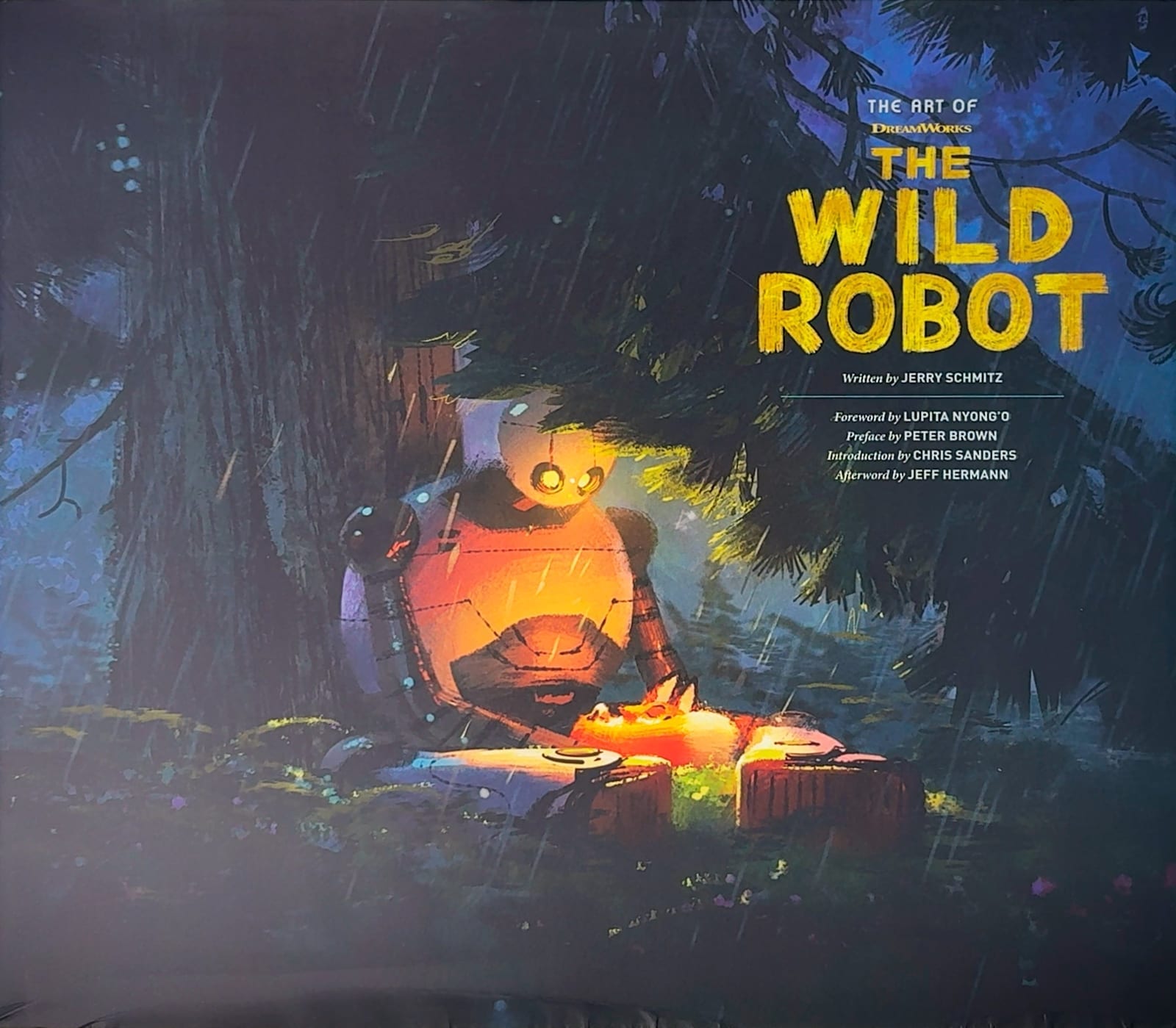
A robot washes up on an island, learns to raise a gosling, and slowly stops being a machine. The Wild Robot took Peter Brown's novel and turned it into the most beautiful-looking thing DreamWorks has ever put on a screen — and The Art of DreamWorks The Wild Robot is the book about how they did it.
Jerry Schmitz put it together, and the list of people who show up in the front matter tells you how much the studio cared about this one: a foreword by Lupita Nyong'o, who voiced Roz, a preface by Peter Brown, who wrote the original book, an introduction by director Chris Sanders, and an afterword from producer Jeff Hermann.
First impressions
It’s a big, heavy Abrams hardcover, and the printing does the film justice — which matters more here than usual, because this movie’s whole identity is brushwork. Get the reproduction wrong and the book falls apart. It doesn’t.
There’s something a little funny about it, too: the concept art in these pages is sometimes indistinguishable from finished frames of the film. That’s not the book flattering itself — it’s a real consequence of how the movie was made, and I’ll get to why.
Content
The Art of DreamWorks The Wild Robot. 176 pages, hardcover, Abrams Books, by Jerry Schmitz. Released September 10, 2024, alongside the film.
There’s also a Deluxe Edition from Cameron Books, which comes in a cloth clamshell box with an exclusive dust jacket, a bookplate signed by Schmitz, five prints from the film’s artists, and — the part I’d actually want — a separate 32-page booklet of Chris Sanders’ own storyboard drawings, signed. If you’re a collector, that’s the one to hunt.
Characters
Roz is the design problem the book keeps returning to, and the solution is lovely.
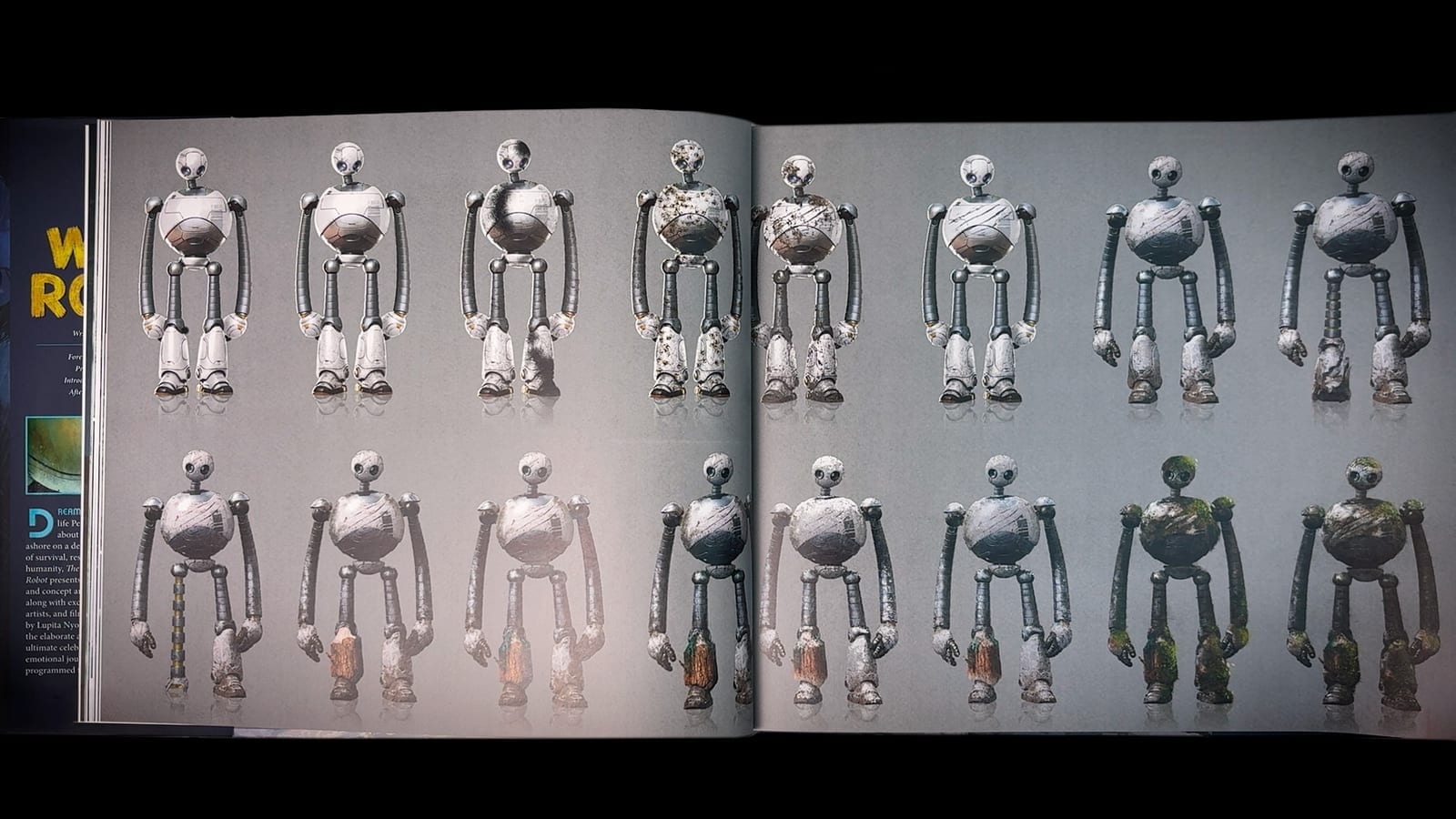
She barely has a face. No mouth, no eyebrows, just optical elements and a head that turns. Instead of fighting that, the team leaned into it — VFX supervisor Jeff Budsberg has talked about how the design emphasises the limitations of this robot, with visible mechanics and real camera-lens components, so she reads as something that was genuinely manufactured. Which is exactly what makes her feel breakable.
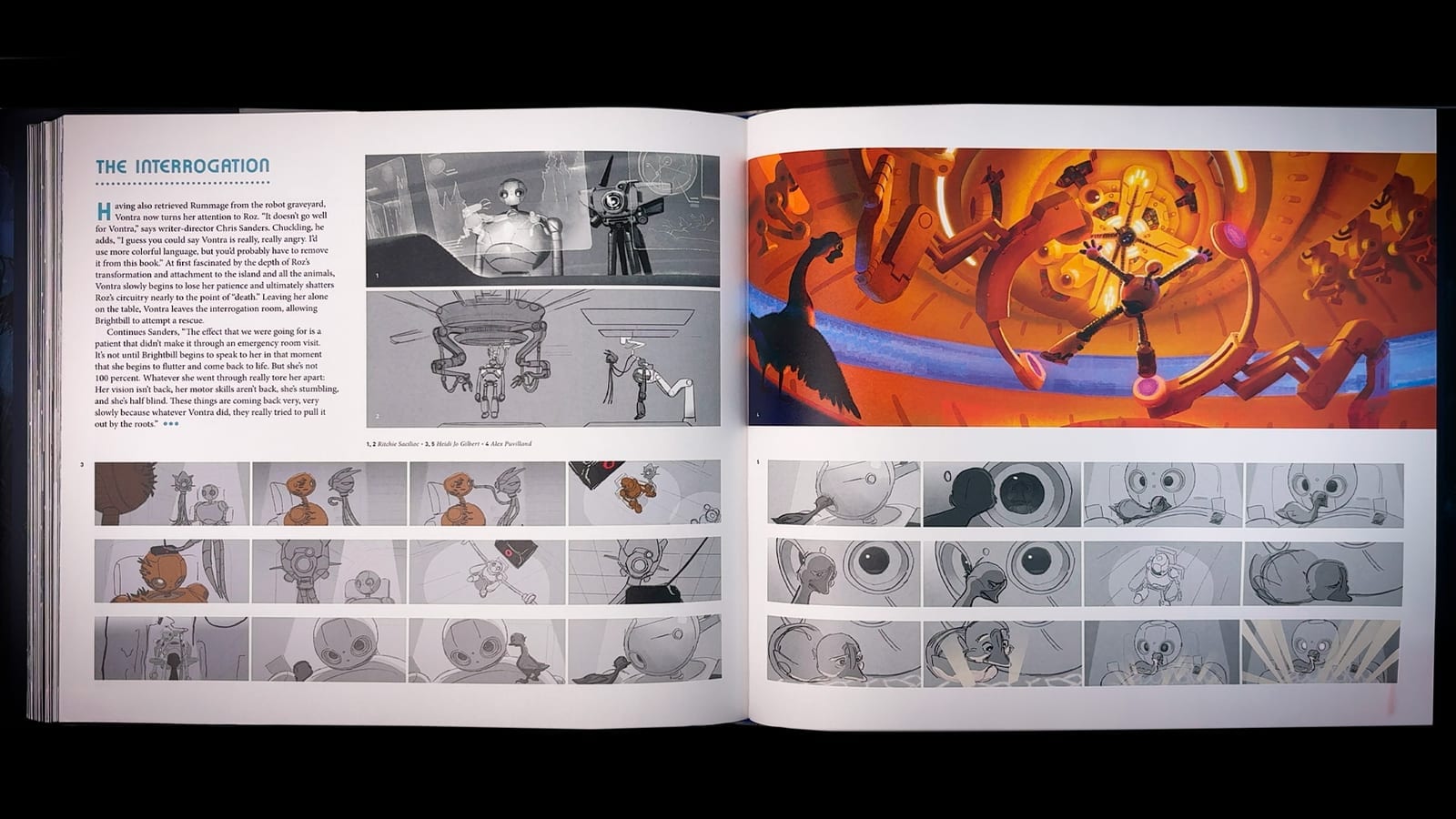
But here’s the detail that made me put the book down for a second: Roz’s rendering changes over the course of the film. She starts out crisp, precise, futuristic — and as the story softens her, the way she’s actually shaded and lit drifts toward the organic, painterly treatment of everything else on the island. Her character arc is built into her surface. Nobody announces it in the movie. You just feel it.
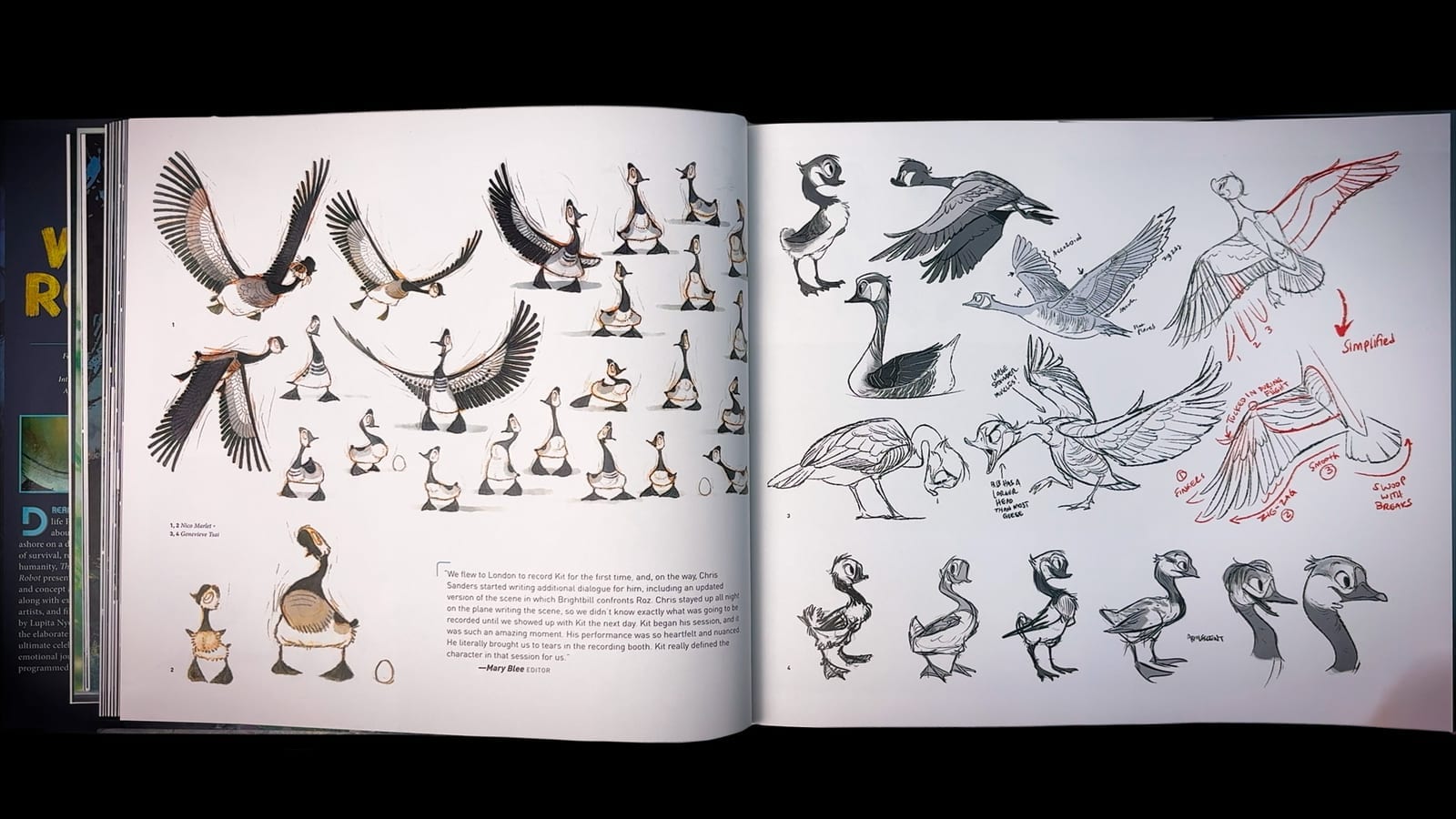
The animals get their own generous section — Brightbill, Fink, Pinktail, the whole ecosystem — with a lot of attention paid to keeping them animals rather than people in fur suits.
The journey through the story
Sanders’ introduction sets out the ambition plainly: he wanted to get back to the handcrafted feeling of Snow White, Bambi and 101 Dalmatians, but in CG. Which sounds like the kind of thing every director says, except this crew actually rebuilt their pipeline to do it.
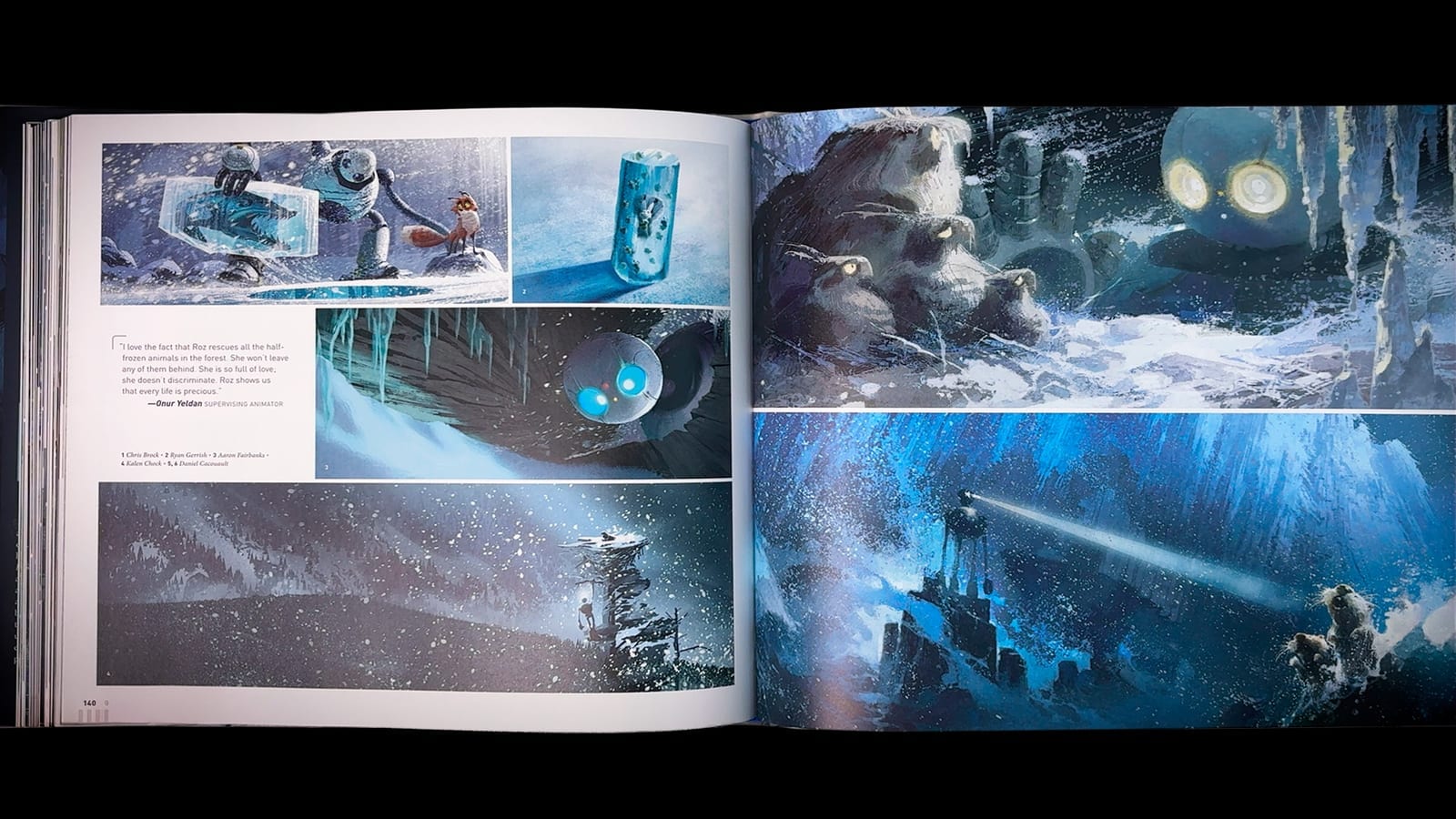
The book walks through that, from Peter Brown’s original illustrations through story reels and color keys to final frames, and Sanders’ storyboards are scattered throughout.
The worlds
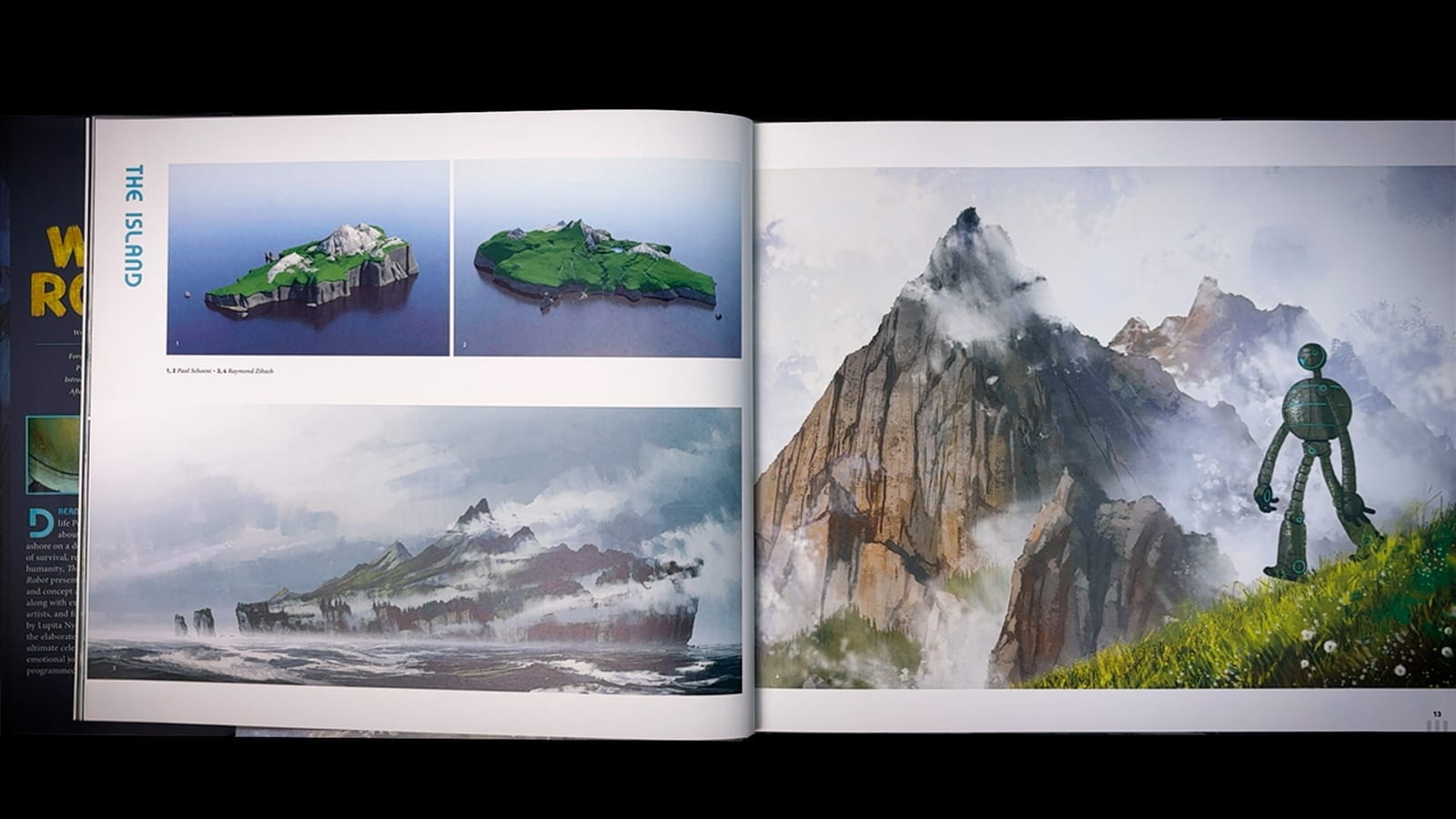
The island is the star, and this is where the book gets genuinely educational.
Production designer Raymond Zibach describes the goal as “a homage to a plein air painting, but a digital impressionistic version of that.” The rule the whole crew worked under came from Budsberg, and it’s the most quotable line in any artbook I’ve read this year: “If you want a painterly bush, paint the bush.”
Meaning: don’t render something realistic and then run a filter over it to make it look painted. Build it painted from the start. In practice that meant artists using a “doodle” tool to draw plants directly as 3D brushstrokes and splatters — leaves that don’t physically connect to anything, flowers that are just a smear of color that happens to sit correctly in space. It meant shaders that deliberately ignore physics, with different texture treatments on the lit side and the shadow side of the same object, the way a painter would actually handle it. Fur and feathers weren’t rendered strand by strand; detail was revealed selectively with light, wet-on-wet.
Even the atmospherics carry brushstrokes — the smoke and the waterfalls have strokes that follow the direction of the flow, like illustration.
The book shows all of this: the layered environment paintings, the migration sequences, the storm, the seasons turning across the island.
What’s inside
The book moves through the production start to finish:
- Character design — Roz’s evolution, and the animal cast from first sketch to final.
- Environments — the island across seasons, weather and time of day.
- Storyboards — including Sanders’ own drawings.
- Visual development — color keys, lighting studies and the painterly-look experiments.
- Interviews — with artists, writers, filmmakers and cast.
“If you want a painterly bush, paint the bush.” — the rule the whole crew worked under.
The artwork
It sits at 4.77 stars on Goodreads, which is about as close to universal love as these books get, and the praise is all in the same direction: the artwork is stunning and there’s a lot of it.
The one criticism worth passing on — because it’s fair — is that some readers found the text repetitive, with a bit too much plot recap and not quite enough on process and strategy. If you’re coming to this specifically to learn how the painterly pipeline works, you’ll get the concepts but not the deep technical dive; that lives in the VFX press coverage, not here. As an art book, though, it delivers exactly what it promises.
Video Preview
New artbook videos every week
Subscribe for more animation and concept art content.
▶ Subscribe on YouTubeIs it worth it?
Yes, and it’s an easy call. This is one of the best-looking animated films of the decade and the book treats the artwork with the respect it deserves.
I’d particularly recommend it if you paint or work in 3D — the environment work is a genuine reference library, and the “build it stylised from the start” philosophy is a useful thing to sit with.
Verdict: a gorgeous book about a gorgeous film, and one of the strongest entries in the DreamWorks art series. Worth the shelf space.
Value
It’s been out since 2024, and that’s good news for your wallet: it currently goes for around $30 / CA$44 / £26 / €34, well under what a 176-page Abrams hardcover of this quality usually costs. At that price it’s an easy yes. The Deluxe Edition costs considerably more and shows up less often; if you want it, don’t wait for a sale that isn’t coming.
If you decide to pick it up, the links at the end of this post are affiliate links. It costs you nothing extra and it helps keep this channel going.
📚 Want this book? Grab your copy:
As an Amazon Associate we earn from qualifying purchases. Other links above are also affiliate links — if you buy through them we may earn a small commission at no extra cost to you.
Stream the film on Peacock in the US
Also available to rent or buy on Apple TV and Prime Video. Availability varies by region, so check your local platform.